
Where to Keep Savings: Current Account, Savings Account or Fixed Term
Know where to keep savings across current, high-yield, and fixed-term accounts. Compare instant liquidity, deposit insurance, and real inflation yields.

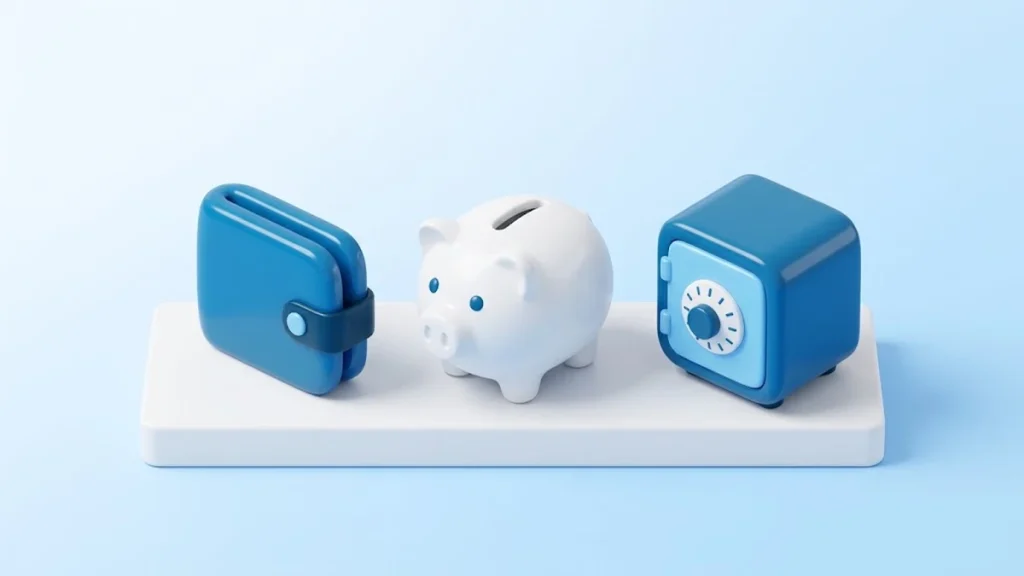
Where you keep your savings determines how fast you can reach it, how much interest it earns, and how safe it is. Get that wrong and the money just sits there losing value.
Most savers leave too much cash sitting in a day-to-day checking or current account, where it earns next to nothing. Inflation quietly erodes that balance over time, and a fat combined balance also tempts you to spend reserves you meant to keep.
This guide covers how to size your cash needs, compare the main account types, check statutory deposit protection limits, and match each pot of money to the right vehicle.
Key takeaways
- Keep checking lean: Maintain one to two months of essential living expenses in your current account to manage monthly bills and cash flow smoothly.
- Easy-access savings for emergencies: An easy-access or high-yield savings account is the primary home for your emergency fund, combining competitive interest with immediate liquidity.
- Fixed terms lock in yield: If you have capital earmarked for a specific goal twelve to thirty-six months away, fixed-term deposits or fixed-rate bonds offer guaranteed interest in exchange for committing your funds.
- Money market funds are investments: Money market funds offer yield close to prevailing central bank rates, but they are investment funds and are not covered by statutory deposit guarantee schemes.
- Know statutory protection limits: Only store cash with institutions backed by official deposit guarantees: $250,000 per depositor under the FDIC in the US, 120,000 pounds per person under the FSCS in the UK (since December 1, 2025), and 100,000 euros under national Deposit Guarantee Schemes across the European Union.
Three questions before you choose: where to keep savings
Evaluate your cash across three core criteria:
1. When will you need the money?
Timeline dictates the liquidity you need. Daily spending requires instant debit access. Emergency reserves must be accessible within one business day. Capital for a home purchase two years out can sit in a term deposit instead, where it earns a higher fixed yield.
2. How much capital are you storing?
Small balances belong in liquid accounts. Large lump sums, such as property sale proceeds, need to be spread across separate banking licenses to stay within statutory guarantee limits.
3. How safe does the capital need to be?
Savings require capital preservation. Unlike equity investments, short-term cash needs nominal principal certainty, backed by a statutory guarantee scheme.
Comparing account types and cash storage options
The table below compares the main cash storage vehicles on access, returns, regulatory protection, and the situations each one suits:
| Account Type | Access Speed | Typical Return Type | Statutory Protection | Best Suited For |
|---|---|---|---|---|
| Current Account (Checking) | Immediate (Debit card, ATM) | Minimal or zero | Yes (FDIC, FSCS, EU DGS) | Daily transactions and monthly bills |
| Easy-Access Savings (HYSA) | Instant to 1 business day | Variable interest rate | Yes (FDIC, FSCS, EU DGS) | Emergency fund and near-term savings |
| Fixed-Term Deposit / Bond | Locked (3 to 36 months) | Guaranteed fixed rate | Yes (FDIC, FSCS, EU DGS) | Earmarked goals with known dates |
| Money Market Fund | 1 to 3 business days | Variable market yield | No statutory deposit insurance | Short-term surplus cash |
To see how compound interest grows your balance over time across these account types, model your own numbers with our free tool:
Current account: for bills, not savings
Your current account handles day-to-day cash flow: salary lands here, and rent, utilities, and groceries leave from it.
Why you should not hoard savings in checking:
- Inflation erosion: Standard current accounts pay near-zero interest, so a few years of leaving surplus cash there quietly costs you real purchasing power.
- Behavioral distortion: When your banking app shows a large combined balance, your brain tends to treat that money as spendable, which makes unplanned purchases easier to justify.
- Card fraud vulnerability: Current accounts connect directly to everyday debit cards. If your card details are stolen, your primary cash reserves could be frozen during a fraud investigation.
Keep your current account balance lean: one to two months of essential living expenses is enough to absorb normal billing cycles without risking an overdraft.
Easy-access savings
An easy-access savings account (or High-Yield Savings Account in North America) holds cash you might need on short notice, kept apart from everyday spending temptation.
Offered by digital banks and credit unions, these accounts pay variable interest that tracks central bank rates.
Key advantages:
- Separation from spending: Keeping your emergency cushion in a separate account creates a small barrier against impulse spending. Moving money back takes a deliberate transfer, not a swipe of a card.
- Compound growth: Interest accrues continuously and is credited monthly, helping your capital keep pace with inflation. You can project your balance growth with our interest on savings calculator.
- Rapid emergency liquidity: If your car breaks down or an appliance fails, you can move money back to your current account within hours.
Review our foundational checklist on building your first emergency cash cushion in how to start saving money.
Fixed-term deposits and bonds
A fixed-term deposit (a Certificate of Deposit, or CD, in the US; a fixed-rate savings bond in the UK) commits an agreed lump sum for a set period, usually between six months and five years.
In exchange for giving up access to your money, the institution guarantees a fixed interest rate for the whole term, which protects your return if the central bank later cuts rates.
The rules differ by country:
- United States: US Certificates of Deposit generally allow early termination, but banks charge an early withdrawal penalty, typically forfeiting three to six months of accrued interest. You can evaluate term options with our CD calculator.
- United Kingdom: UK fixed-rate bonds often permit no early withdrawals at all. Once your deposit is placed, the funds stay locked until maturity.
Use fixed-term vehicles only for money tied to a definite future milestone, such as a property purchase planned eighteen months out. Never lock your baseline emergency reserves into fixed-term products.
Money market funds
Money market funds (MMFs) are mutual funds that invest in ultra-short-term, high-quality debt, including government treasury bills, commercial paper, and repurchase agreements.
Many brokerages sweep idle cash into money market funds so it earns yields close to interbank rates.
The one thing to know:
Money market funds are investment products, not bank deposits. They are not covered by deposit guarantee schemes like the FDIC, FSCS, or EU DGS. High-grade government funds carry minimal default risk, but they still do not guarantee nominal returns. Use them for investment dry powder, not insured emergency reserves.
How deposit protection works
Never store personal savings in an institution that lacks statutory deposit insurance. If an authorized institution becomes insolvent, government safety nets guarantee depositor balances up to legal thresholds:
- United States: Up to $250,000 per depositor, per insured institution, administered by the Federal Deposit Insurance Corporation (FDIC) or the National Credit Union Administration (NCUA).
- United Kingdom: Up to 120,000 pounds per person, per authorized banking group, administered by the Financial Services Compensation Scheme (FSCS). This statutory limit was raised to 120,000 pounds on December 1, 2025.
- European Union: Up to 100,000 euros per depositor, per credit institution, under national Deposit Guarantee Schemes compliant with EU Directive 2014/49/EU.
Temporary high balance protection:
If a major life event leaves you holding an unusually large cash balance, such as selling your home, receiving an inheritance, or an insurance settlement, statutory rules provide extra temporary protection above the standard ceilings. In the UK, the FSCS protects qualifying temporary high balances up to 1.4 million pounds for up to six months from the date the funds were deposited (the Prudential Regulation Authority raised this from the previous 1 million pound ceiling on December 1, 2025). Several EU countries offer similar protection for property transactions: the Dutch Central Bank (DNB), for instance, protects home-sale proceeds up to 500,000 euros for three months after the sale.
Outside of temporary high balance provisions, if your total savings exceed statutory caps, spread your balances across separate institutions operating under distinct banking licenses.
Matching each pot to a goal
Structure your personal cash across three clear operational buckets:
- Transaction Buffer (Current Account): One to two months of essential expenses to cover daily spending and scheduled direct debits.
- Emergency Cushion (Easy-Access Savings): Three to six months of living expenses in an instant-access account with full deposit insurance.
- Targeted Savings (Fixed Terms or Dedicated Pots): Known medium-term expenses placed into fixed-term deposits or earmarked sub-accounts.
To check whether your savings interest is outpacing cost-of-living increases, compare your net yields with our real rate of return calculator. For a broader financial management framework, see our guide on how to manage your money.
Frequently asked questions
Can I lose money in a high-yield savings account?
Inside an insured savings account within statutory limits ($250,000 FDIC, 120,000 pounds FSCS, or 100,000 euros EU DGS), your nominal capital is fully protected against bank insolvency. You can still lose purchasing power, though, if after-tax interest lags behind inflation. If you hold funds through a fintech app rather than a bank directly, FDIC or FSCS coverage only applies if that fintech runs pass-through deposit arrangements with an underlying licensed partner bank.
What is the difference between APR and APY on a savings account?
Annual Percentage Rate (APR) is the simple nominal interest rate over a year, without compounding. Annual Percentage Yield (APY) includes the effect of compounding. Because most savings accounts compound daily, APY runs slightly higher than the nominal APR and is the number that reflects your actual annual return. Compare the compounding difference directly with our APR vs APY calculator.
Should I keep my savings in the same bank as my current account?
Keeping savings at a separate digital bank has two real advantages: online-only institutions typically pay higher interest because they carry lower overhead, and the transfer delay between your savings and your debit card makes impulse spending harder.
The one next step
Check your current account balance today. If it holds more than two months of living expenses, open an insured easy-access savings account and set up an automated transfer to move the surplus into a yield-earning account.
Sources
Fact-checked on September 28, 2026 against the sources below.
- Financial Services Compensation Scheme (FSCS): Compensation limits and temporary high balance protection rules. https://www.fscs.org.uk/what-we-cover/banks-building-societies/
- Federal Deposit Insurance Corporation (FDIC): Deposit insurance coverage limits and third-party deposit arrangements. https://www.fdic.gov/resources/deposit-insurance/
- European Commission: Deposit Guarantee Schemes Directive (2014/49/EU) – 100,000 EUR depositor protection standards. https://finance.ec.europa.eu/banking-and-banking-union/banking-rules/deposit-guarantee-schemes_en
- De Nederlandsche Bank (DNB): Dutch Deposit Guarantee Scheme and temporary high balance provisions. https://www.dnb.nl/en/reliable-financial-sector/deposit-guarantee-scheme/
- Consumer Financial Protection Bureau (CFPB): Guide to checking accounts, savings accounts, and certificates of deposit. https://www.consumerfinance.gov/consumer-tools/save-for-unexpected-events/
This article is for general information only and is not financial, tax or legal advice. Rules and rates change; check the official sources listed above or speak to a qualified adviser before making a decision.