
How to Manage Money: A Practical System for Your 20s and 30s
Learn how to manage money with a proven 3-account system for your 20s and 30s. Automate your income, eliminate lifestyle creep, and build lasting wealth.


Learning how to manage money in your twenties and thirties is not about tracking every cup of coffee on an agonizing spreadsheet. Real financial control comes from building a simple, automated system that routes your income where it needs to go before you have a chance to spend it.
To manage your money effectively, establish a three-account structure on payday: one checking account dedicated strictly to fixed bills, one spending account with a debit card for everyday life, and a separate high-yield savings account for your cash buffer. When your recurring commitments and future savings are handled automatically the morning your salary clears, whatever remains in your spending account is yours to use without stress or guilt.
Here is the five-part checklist to set up your personal money system:
- Separate bills from daily spending. Open two checking accounts so essential living costs never mix with discretionary spending.
- Automate savings on payday. Schedule standing transfers into savings and investments the moment your paycheck arrives.
- Keep a starter cash buffer of one month of expenses. Protect your cash flow from unexpected setbacks without resorting to credit cards.
- Eliminate high-interest consumer debt aggressively. Prioritize paying off balances charging interest above 8 percent APR before funding non-essential goals.
- Run an annual twenty-minute review. Audit recurring subscriptions, renegotiate utility contracts, and increase your automated savings rate with every raise.
Key takeaways
- Learning how to manage money succeeds through automated structure rather than daily willpower.
- A three-account structure prevents fixed household obligations from competing against everyday spending.
- Assigning broad percentages to automated accounts creates lasting consistency without tracking every penny.
- High-interest debt is any balance above about 8 percent APR; clear it before investing beyond an employer match.
- Build a starter buffer of one month of essential expenses first, then work toward a full emergency fund of three to six months.
- Capture your full employer retirement match immediately; a 50 percent match is an instant 50 percent return on your money.
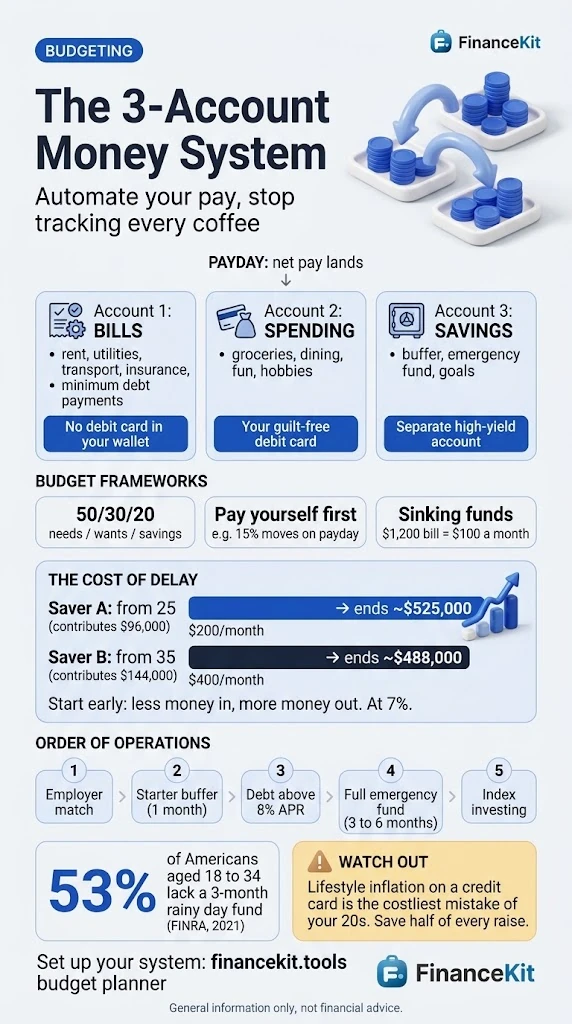
The five parts of a sustainable money system
Most personal finance advice fails because it assumes human beings operate like calculating machines. Traditional budgeting demands that you record every receipt, classify dozens of distinct subcategories, and exercise unrelenting discipline thirty-one days a month. By week three, fatigue sets in, a single unplanned dinner blows the budget, and the entire system collapses.
A sustainable money system functions through clear structure: you set up the accounts once, establish the transfers, and allow automation to handle the distribution. The system consists of five distinct components:
- The Income Hub: The primary bills checking account where your net take-home pay lands.
- Fixed Living Costs: Essential housing, utilities, insurance, transit, and minimum debt payments.
- The Buffer and Emergency Fund: Liquid cash reserves that prevent life surprises from turning into debt.
- Debt Elimination and Long-Term Investing: Systematic payoff of consumer balances followed by automated index investing.
- Everyday Spending: The remaining allowance allocated strictly for food, leisure, hobbies, and personal choices.
When each dollar has an assigned role before the month begins, you never have to wonder whether you can afford dinner with friends. If the money sits in your spending account, it is already cleared for use.
How to manage money with the three-account system
The single most effective structural change you can make in your twenties is separating your bills from your daily spending cash. When rent money and leisure money sit in the same checking account, your brain perceives the entire balance as available cash. You spend comfortably in the first two weeks of the month, only to experience anxiety during the final ten days when insurance premiums or utility bills clear.
To fix this, organize your banking into three distinct accounts:
Account 1: The Fixed Bills Account (Checking)
This is your primary administrative account where your net take-home salary is deposited. All fixed recurring commitments are paid directly from this account via direct debit or automated bill pay:
- Rent or mortgage payments
- Electricity, heating, water, and internet
- Transit passes, fuel, and car insurance
- Minimum debt obligations and health insurance
Calculate the total monthly cost of these fixed commitments, add a small 5 percent cushion for seasonal utility variations, and let that amount remain in this account. You do not carry a debit card for this account in your physical wallet.
Account 2: The Daily Spending Account (Checking)
This is your lifestyle and variable expense account. Every payday, an automated transfer moves your allocated spending allowance from Account 1 into Account 2. This account funds:
- Groceries and dining out
- Entertainment, social gatherings, and coffee
- Clothing, personal care, and hobbies
- Weekend recreation
This account comes with your primary debit card. When the balance in Account 2 drops low near the end of the pay cycle, you naturally slow down your social spending until next payday. Your rent and essential bills in Account 1 remain completely untouched and secure.
Account 3: The Savings and Buffer Account (High-Yield Savings)
This account sits at a separate institution or in dedicated sub-accounts. It holds your starter cash buffer, your full emergency fund, and short-term savings targets. Keeping it separate prevents accidental transfers while ensuring your cash earns competitive interest protected by statutory deposit insurance.
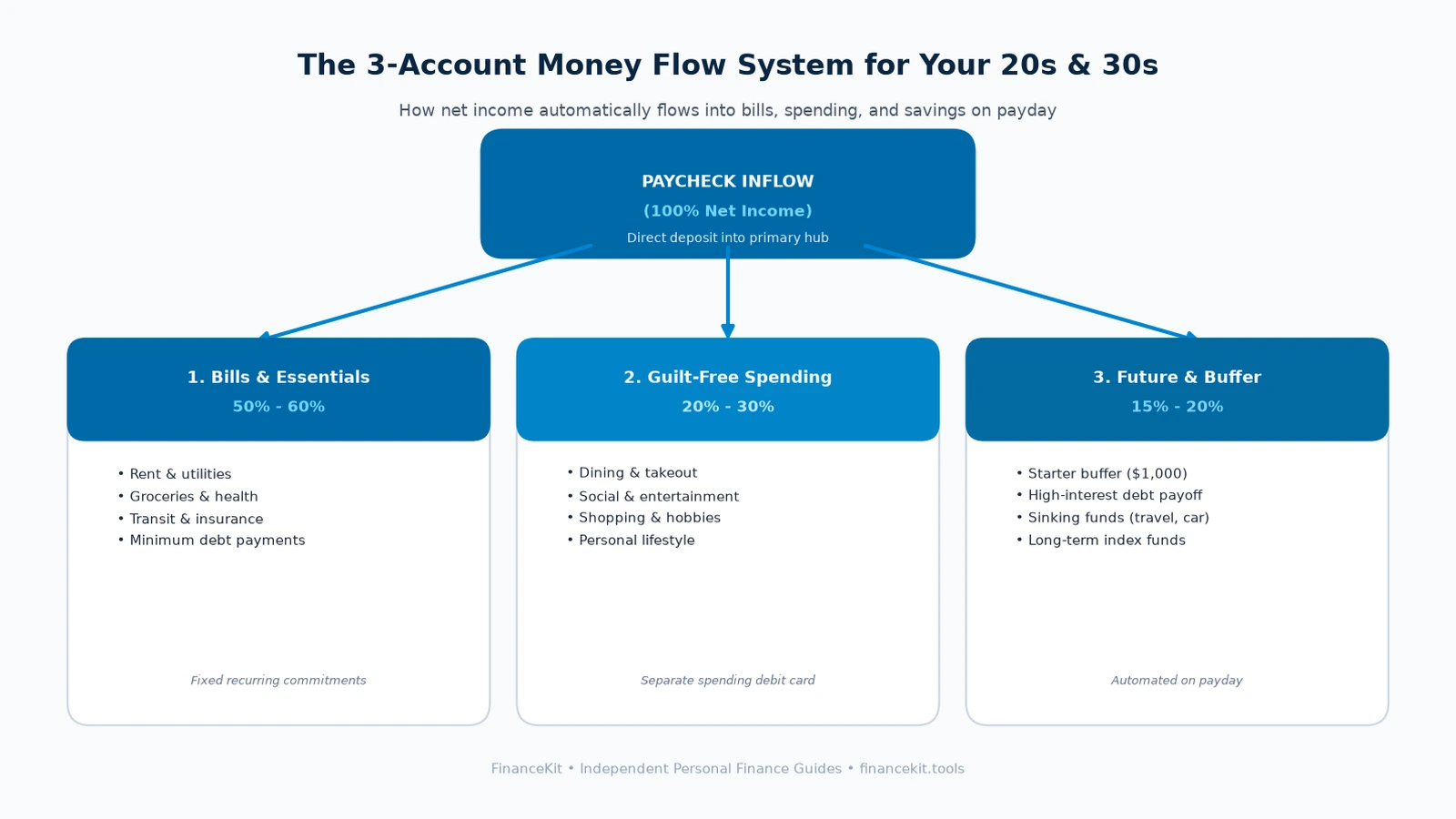
Use our budget planner to organize your essential fixed costs, flexible spending, and automated savings in minutes.
Pick a budgeting framework you can actually keep
A budget is an intentional choice about how your money serves your goals, not a restriction on your freedom. The key is choosing a framework that matches your situation without creating unnecessary administrative burden:
1. The Proportional Budget (50/30/20)
Popularized by Elizabeth Warren and Amelia Warren Tyagi in their 2005 book All Your Worth: The Ultimate Lifetime Money Plan, this framework divides net take-home pay into 50 percent needs, 30 percent wants, and 20 percent savings and debt payoff. If housing costs in your city push needs to 60 percent, adjust your proportions accordingly; the value lies in establishing intentional spending limits. You can model your allocation and track your progress with our savings rate calculator.
2. The Pay-Yourself-First Method
If tracking categories feels tedious, pay-yourself-first is the simplest approach. Choose a savings target, such as 15 percent of your net pay. The morning your salary arrives, that 15 percent transfers automatically into savings and investment accounts. The remaining 85 percent covers your bills and everyday spending without ongoing itemization.
3. Sinking Funds for Irregular Costs
Unexpected bills are rarely true surprises. Car maintenance occurs periodically, annual insurance premiums arrive every twelve months, and holidays occur on schedule. Set up dedicated sub-accounts for known future expenses. For example, if annual car insurance is $1,200 due in November, transfer $100 every month into an insurance sinking fund so the cash is waiting when the bill arrives.
Build the buffer before taking big risks
According to the FINRA Investor Education Foundation 2021 National Financial Capability Study (NFCS), 53 percent of Americans aged 18 to 34 reported that they do not have rainy day funds set aside to cover three months of unanticipated expenses.
Without a cash safety net, any minor disruption, such as a flat tyre, a dental visit, or a broken home appliance, forces you to borrow money or skip bills. Build your reserves in two sequential stages:
- Stage 1: The Starter Buffer (about $1,000 or one month of essential expenses). This is your immediate shock absorber. As outlined in our guide on how to start saving money, accumulating your first cash reserve creates the stability required to tackle debt without sliding backward.
- Stage 2: The Full Emergency Fund (3 to 6 months of essential living costs). Once high-interest consumer debt is cleared, expand your reserve to cover three to six months of basic living expenses in an accessible high-yield savings account.
To determine your target cash reserve based on your household expenses, calculate your figures with our emergency fund calculator.
Deal with high-interest debt decisively
Not all debt carries the same urgency. A fixed low-rate student loan or a sensible mortgage has manageable carrying costs, but consumer debt compounds against you rapidly.
According to the Federal Reserve Statistical Release G.19 (Consumer Credit), the average interest rate on commercial bank credit card accounts assessed interest stood at 22.76 percent in the second quarter of 2024. At 22 percent APR, carrying a $4,000 balance costs almost $900 annually in interest charges alone without reducing the underlying principal balance.
Because paying down debt provides a guaranteed financial return equal to the interest rate avoided, clearing high-interest debt (any balance above about 8 percent APR) is mathematically the most reliable financial investment available.
Choose one of two proven debt payoff strategies:
- The Avalanche Method: List debts by interest rate from highest to lowest. Pay minimums on all accounts and direct all extra cash to the balance with the highest APR. This approach minimizes total interest paid.
- The Snowball Method: List debts by balance from smallest to largest. Pay minimums on all accounts and attack the smallest balance first. Clearing accounts quickly provides psychological momentum.
Whichever method you pick, the priority stays the same: clear the highest-cost balances first. You can compare payoff timelines and total interest costs using our debt payoff calculator.
Start investing for the long term
Once your starter buffer is in place and your high-interest debt is eliminated, time becomes your most powerful asset. Every dollar invested in your twenties and thirties has decades to compound.
To understand the impact of starting early, consider two savers investing in diversified index funds at a 7 percent annualized nominal return with monthly compounding:
- Saver A begins at age 25, investing $200 each month until age 65. Over 40 years, Saver A contributes $96,000 out of pocket and finishes with approximately $525,000.
- Saver B waits until age 35 to begin, investing $400 each month until age 65. Over 30 years, Saver B contributes $144,000 out of pocket (50 percent more money) but finishes with approximately $488,000.
Starting ten years earlier allows Saver A to build a larger balance while contributing $48,000 less of their own wages. You can test your own savings amounts and compounding horizons with our compound interest calculator.
Follow these four principles when beginning:
- Capture your employer match: If your employer offers a retirement contribution match (such as a 401k or workplace pension match), contribute enough to capture the full match. This is free money from your employer; a 50 percent match represents an instant 50 percent return on your contribution. Be aware of your employer’s vesting schedule, which determines when matched funds belong to you permanently.
- Use tax-advantaged accounts: Take advantage of individual retirement accounts (such as a Roth IRA in the US or an ISA in the UK) where investment returns grow sheltered from annual taxes.
- Choose low-cost broad-market index funds: Avoid speculative trading and single-stock picking. Broadly diversified index funds provide ownership across thousands of productive companies with minimal annual expense ratios.
- Automate contributions: Schedule your investment transfers to execute automatically the day after payday, treating future security as a fixed commitment.
For building long-term wealth, selecting low-cost index funds and establishing recurring contributions forms the foundation of sustainable investing.
The annual money review
Your financial system requires periodic adjustments as your career and life evolve. Set aside twenty minutes once a year to keep your system aligned:
- Audit recurring subscriptions: Review statements for streaming services, digital memberships, or gym contracts you no longer use.
- Shop recurring insurance policies: Compare auto, home, and renters insurance quotes to ensure rates remain competitive.
- Save half of every pay raise: Whenever your income increases, allocate at least half of the net raise toward automated savings and investments before expanding your lifestyle.
- Adjust your safety buffer: If your rent or essential living expenses increased over the past year, update your emergency fund balance to reflect your new monthly baseline.
Frequently asked questions
How much money should I have saved by age 30?
A widely referenced guideline from Fidelity Investments suggests aiming to have the equivalent of one year of your gross annual salary saved for retirement by age 30, based on saving 15 percent of income starting at age 25. However, this is an aspirational rule of thumb rather than a universal requirement. If you spent your twenties paying off student debt or training for a career, your savings may be lower. What matters most is having an automated savings habit in place and no high-interest debt.
Should I pay off debt or invest first?
Capture any employer retirement match first, as it provides an immediate financial return. Next, secure a starter cash buffer of one month of essential expenses. If your debt carries an interest rate above about 8 percent APR (such as credit cards or high-interest personal loans), prioritize paying it off before investing additional money. For low-rate fixed debts below 4 to 5 percent, making regular payments while investing surplus funds in diversified accounts is generally sound.
How do I manage money with an irregular freelance income?
Establish a business holding account where all client payments land. Pay yourself a fixed, predictable monthly salary from this holding account into your personal bills checking account on the first of each month. In high-income months, surplus revenue builds up in the holding account to cushion leaner months, keeping your household cash flow steady.
What is the most common financial mistake in your 20s?
The most damaging mistake is lifestyle inflation financed by credit card debt. When income increases from entry-level positions, spending on dining, car leases, and apartments can easily outpace earnings. Paying 20 percent interest on consumable lifestyle expenses erodes your ability to build wealth during your most valuable compounding years.
How many bank accounts do I actually need?
A three-account structure is optimal for most people: one checking account for fixed recurring bills, one checking account with a debit card for everyday variable spending, and one high-yield savings account for your emergency buffer and short-term goals.
The one next step
Open your banking app today and schedule an automatic transfer of 10 percent of your next paycheck directly into a separate savings account, set to execute the day after payday. Establishing this automated transfer shifts your finances from reactive stress to steady progress.
Sources
Fact-checked on September 28, 2026 against the sources below.
- FINRA Investor Education Foundation: National Financial Capability Study (NFCS 2021 Report, question on 3-month rainy day funds). https://www.usfinancialcapability.org/downloads/NFCS_2021_Report_Natl_Findings.pdf
- Board of Governors of the Federal Reserve System: Statistical Release G.19 Consumer Credit (May 2024 / Q2 2024 report on commercial bank credit card interest rates). https://www.federalreserve.gov/releases/g19/current/
- Warren, Elizabeth and Tyagi, Amelia Warren: All Your Worth: The Ultimate Lifetime Money Plan (Free Press, 2005).
- Fidelity Investments: Retirement Savings Guidelines by Age (Fidelity Viewpoints). https://www.fidelity.com/viewpoints/retirement/how-much-money-should-I-save
- Consumer Financial Protection Bureau (CFPB): An essential guide to building an emergency fund. https://www.consumerfinance.gov/consumer-tools/save-for-unexpected-events/
This article is for general information only and is not financial, tax or legal advice. Rules and rates change; check the official sources listed above or speak to a qualified adviser before making a decision.