
Buying Your First Home: A First Time Home Buyer Guide
The essential first time home buyer guide: calculate real affordability, navigate closing costs, check your credit score, and secure mortgage pre-approval.


Buying a first home is frequently the largest single financial transaction of your lifetime. It is an exciting milestone, but navigating mortgage pre-approval, closing costs, inspections, and moving fees can quickly become overwhelming without a structured roadmap.
This comprehensive first time home buyer guide walks you through the financial realities of purchasing property, from auditing your credit score to collecting the keys at closing.
According to data from Freddie Mac and the Consumer Financial Protection Bureau (CFPB), closing costs typically add between 2 and 5 percent of the total purchase price to your upfront cash requirement, over and above your down payment. Without thorough preparation, these overlooked fees can deplete your cash reserves right as you take on the responsibilities of homeownership.
Here is the seven-step checklist to guide your home-buying journey:
- Calculate your true upfront cash requirement. Account for your down payment, closing costs (2 to 5 percent of the purchase price), and an intact emergency buffer.
- Review your credit score and credit profile. Aim for a score of 620 or higher for conventional loans, or 580 for standard FHA financing.
- Obtain mortgage pre-approval. Secure a verified pre-approval letter based on documented income and tax returns before viewing homes.
- Determine a realistic purchase budget. Keep your total monthly housing cost within safe debt-to-income boundaries.
- Make an offer and negotiate terms. Include standard appraisal, financing, and home inspection contingencies in your purchase contract.
- Conduct professional property inspections and title checks. Uncover hidden structural flaws and confirm clean legal ownership before closing.
- Complete closing and prepare for moving. Review the Closing Disclosure document, wire closing funds, and maintain a post-move maintenance reserve.
Key takeaways
- Your total cash needed on closing day equals your down payment plus 2 to 5 percent of the purchase price in closing costs.
- Never drain your entire bank account for a down payment; keep three to six months of living expenses in an emergency fund.
- Mortgage pre-approval carries far more weight than simple pre-qualification because an underwriter verifies your documents.
- FHA loans require an upfront and annual Mortgage Insurance Premium (MIP), while conventional loans require Private Mortgage Insurance (PMI) if you put down less than 20 percent.
- Conventional PMI can be removed upon request at 20 percent home equity and terminates automatically at 22 percent equity under the Homeowners Protection Act.
- In the UK, first-time buyers benefit from Stamp Duty Land Tax (SDLT) relief on purchases up to statutory thresholds.

First time home buyer guide: the 7-step financial checklist
Step 1: Calculate your true upfront cash requirement
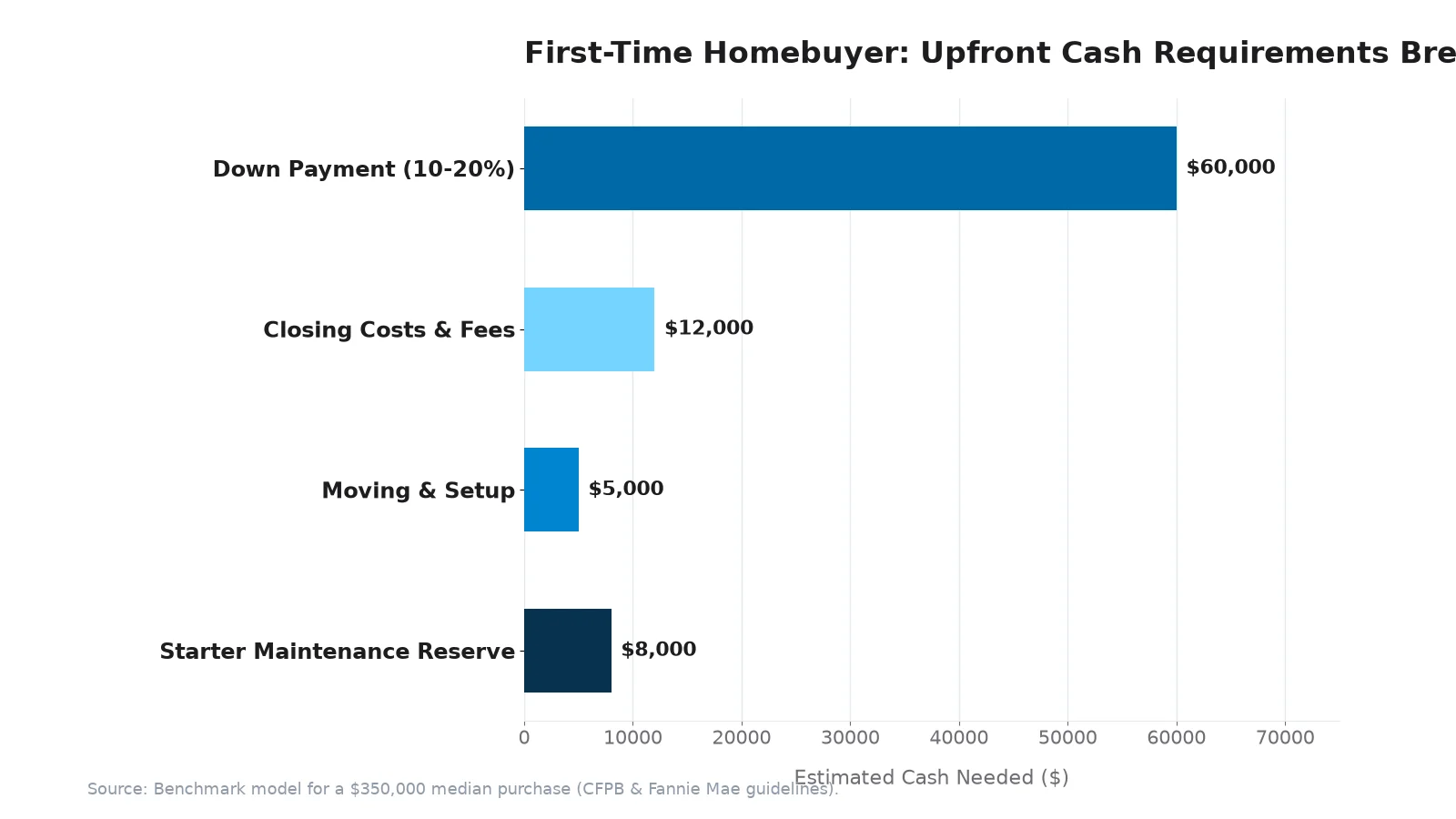
Most prospective buyers focus exclusively on saving for the down payment, assuming that reaching a 5 or 10 percent target is sufficient. In reality, buyers must fund three distinct cash pools simultaneously:
1. The Down Payment
While a 20 percent down payment eliminates mortgage insurance, many first-time buyers purchase with less:
- Conventional loans: Minimum 3 percent down for qualified first-time buyers through programs like Fannie Mae HomeReady or Freddie Mac Home Possible.
- FHA loans: Minimum 3.5 percent down with a credit score of 580 or higher (Federal Housing Administration).
- VA and USDA loans: Zero percent down payment options for eligible military veterans and qualifying rural home buyers.
2. Closing Costs (2% to 5% of purchase price)
Closing costs cover loan origination, third-party underwriting, title searches, lender title insurance, prepaid property taxes, and home appraisal fees. On a $350,000 home, expect closing costs to range from $7,000 to $17,500.
3. The Untouchable Emergency Buffer
Never close on a home with an empty savings account. Maintain three to six months of essential living expenses in an accessible high-yield savings account after all down payment and closing funds have cleared. When a water heater fails or a plumbing leak develops in your second month of ownership, your emergency fund protects you from high-interest credit card debt.
You can calculate how long it will take to reach your target savings with our down payment timeline calculator.
Step 2: Check your credit score and debt-to-income ratio
Lenders evaluate your borrowing profile through two primary metrics: your credit score and your Debt-to-Income (DTI) ratio.
Credit Score Thresholds
- Conventional financing: 620 minimum score, though scores above 740 receive the lowest interest rates and cheapest private mortgage insurance.
- FHA financing: 580 minimum for a 3.5 percent down payment, or 500 to 579 with a 10 percent down payment.
Avoid opening new credit card accounts, taking out auto loans, or co-signing debt during the six to twelve months leading up to a mortgage application. Every new debt inquiry can ding your credit score and increase your monthly obligations.
Debt-to-Income (DTI) Guidelines
Your DTI represents the percentage of your gross monthly income committed to recurring debt payments. Lenders look at two ratios:
- Front-end ratio: Monthly housing costs (mortgage principal, interest, taxes, insurance, and HOA dues) divided by gross monthly income.
- Back-end ratio: All monthly debt obligations (housing plus student loans, auto loans, and credit card minimums) divided by gross income.
A classic benchmark is the 28/36 guideline, where housing should not exceed 28 percent and total debt should not exceed 36 percent of gross income, though many loan programs allow total DTIs up to 43 percent or higher depending on compensating factors.
Determine how much you can comfortably spend each month using our free home affordability calculator.
Step 3: Get pre-approved before viewing homes
Do not confuse pre-qualification with pre-approval:
- Pre-qualification: An informal estimate based on self-reported income and assets, with no verification. It carries little weight with sellers.
- Pre-approval: A formal assessment where an underwriter pulls your credit report, reviews W-2 forms, tax returns, and bank statements, and issues a written commitment stating the maximum loan amount you qualify for.
When you submit an offer in a competitive market, listing agents will verify your pre-approval letter before taking your bid to the seller.
Shop with at least three different lenders: retail banks, credit unions, and independent mortgage brokers. The CFPB notes that comparing multiple loan quotes typically saves buyers thousands of dollars in interest charges over the life of a mortgage.
Step 4: Determine a realistic property budget
Just because a bank approves you for a $450,000 mortgage does not mean you should borrow that amount. Banks calculate what you can theoretically pay based on gross income, without considering your personal lifestyle, travel goals, childcare costs, or retirement savings habits.
Calculate your complete monthly housing expense, known by the acronym PITI:
- Principal: The portion of your payment reducing loan balance.
- Interest: The finance charge paid to the lender.
- Taxes: Local municipal and school property taxes, often collected in an escrow account.
- Insurance: Homeowners hazard insurance and mortgage insurance (PMI or MIP).
- HOA Fees: Monthly dues if purchasing a condominium or home within a homeowner association.
To compare monthly principal and interest across different loan terms, use our mortgage payment calculator. If you are debating whether homeownership makes sense right now compared to your current lease, test both paths in our rent vs buy calculator.
Step 5: Make an offer and negotiate terms
Once you locate a home that fits your criteria, your real estate agent prepares a formal purchase agreement.
Ensure your offer includes essential protective contingencies:
- Financing contingency: Allows you to cancel the contract and retrieve your earnest money deposit if your mortgage application is denied.
- Appraisal contingency: Protects you if the lender’s professional appraiser values the property lower than your agreed purchase price.
- Inspection contingency: Grants you the right to inspect the property with licensed professionals and negotiate repairs, price credits, or terminate the purchase if severe defects are uncovered.
Include an earnest money deposit (typically 1 to 2 percent of the purchase price), which is held in escrow and applied toward your down payment at closing.
Step 6: Surveys, inspections, and legal checks
Never skip a comprehensive home inspection to make an offer more attractive. A standard inspection examines:
- Foundation, structural framing, and roof condition
- Electrical panel, wiring, and code compliance
- Heating, ventilation, and air conditioning (HVAC) systems
- Plumbing lines, water pressure, and drainage
- Evidence of water intrusion or pest infestation
If the inspection reveals significant safety hazards (such as failing roofing or outdated electrical wiring), ask the seller to complete repairs prior to closing or provide a closing cost credit.
Concurrently, a title company or real estate attorney conducts a title search to ensure there are no legal liens, unpaid tax assessments, or boundary disputes encumbering the property. Always purchase an owner’s title insurance policy to protect your equity against future unrecorded ownership claims.
Step 7: Completion, closing costs, and moving
At least three business days before your scheduled closing date, your lender is legally required by federal regulations (the TRID rule) to provide your Closing Disclosure (CD) document.
Carefully compare your Closing Disclosure against the initial Loan Estimate you received when applying:
- Verify that the loan amount, interest rate, and monthly payment match your expectations.
- Check that lender origination fees have not increased without justification.
- Note the exact “Cash to Close” figure required for wire transfer.
On closing day, you sign loan documents, pay your down payment and closing costs via certified wire transfer, and receive the keys to your new home.
Costs first-time buyers frequently miss
Beyond the purchase price, budget for these immediate post-closing expenses:
- Immediate moving truck and packing supplies ($500 to $2,000)
- Utility connection deposits and municipal transfer fees
- Lock rekeying and basic security upgrades ($150 to $350)
- Basic maintenance tools (lawnmower, snow shovel, ladder, toolkit)
- Ongoing home maintenance: budget 1 to 2 percent of your home’s total value annually for routine upkeep and repairs.
In the UK: First-time buyer considerations
If you are buying property in the United Kingdom, the process follows distinct terminology and statutory rules:
- Agreement in Principle (AIP): Obtain an AIP or Decision in Principle from a mortgage lender before viewing properties to demonstrate purchasing credibility to estate agents.
- Conveyancing: Instruct a licensed conveyancer or solicitor to carry out local authority searches, land registry checks, and draft contracts.
- Surveys: Commission an independent RICS (Royal Institution of Chartered Surveyors) HomeBuyer Report or full building survey, as mortgage valuations are conducted solely for the lender’s benefit.
- Stamp Duty Land Tax (SDLT) Relief: First-time buyers in England and Northern Ireland benefit from relief thresholds on qualifying residential purchases. Verify current rates and relief conditions on GOV.UK before calculating cash requirements.
Frequently asked questions
What is the difference between PMI and FHA MIP?
Conventional loans require Private Mortgage Insurance (PMI) when you put down less than 20 percent. Under the Homeowners Protection Act of 1998, you can request PMI cancellation when your loan balance reaches 80 percent of original home value, and it cancels automatically at 78 percent loan-to-value (22 percent equity). FHA loans require both an upfront Mortgage Insurance Premium (MIP) and an annual MIP. For FHA loans with less than 10 percent down, annual MIP remains in effect for the entire life of the mortgage loan unless refinanced into a conventional loan.
Can I use gift money from parents for my down payment?
Yes, most loan programs allow down payment gifts from immediate family members. However, the funds must be accompanied by a formal gift letter confirming that the money is an outright gift with no requirement or expectation of repayment.
How much should I budget for home maintenance each year?
A standard rule of thumb is to budget between 1 and 2 percent of the home’s total value annually for routine maintenance and long-term capital replacements (such as roof, furnace, or exterior painting). A $300,000 home warrants setting aside $3,000 to $6,000 per year into a dedicated home maintenance sinking fund.
What happens if the home appraisal comes in low?
If the lender’s appraisal is lower than your agreed purchase price, the lender will only base your loan amount on the appraised value. You can renegotiate the purchase price down with the seller, make up the cash difference out of pocket, or exercise your appraisal contingency to walk away with your earnest money intact.
The one next step
Pull your credit reports from annualcreditreport.com today. Check for erroneous collections, incorrect balances, or outdated accounts, and dispute any errors immediately before submitting your first mortgage application.
Sources
Fact-checked on September 28, 2026 against the sources below.
- Consumer Financial Protection Bureau (CFPB): Buying a House – Tools and resources for home buyers. https://www.consumerfinance.gov/owning-a-home/
- Freddie Mac: Single-Family Mortgage Guidelines and Closing Costs Overview. https://myhome.freddiemac.com/buying/closing-costs
- Federal Housing Administration (HUD/FHA): 203(b) Mortgage Insurance Program and Down Payment Requirements. https://www.hud.gov/program_offices/housing/sfh/ins/203b–df
- Fannie Mae: HomeReady Mortgage Program guidelines and eligibility criteria. https://singlefamily.fanniemae.com/originating-underwriting/mortgage-products/homeready-mortgage
- Federal Trade Commission (FTC): Homeowners Protection Act of 1998 (PMI Cancellation Rights). https://consumer.ftc.gov/articles/mortgages-buying-home
- HM Revenue & Customs (HMRC): Stamp Duty Land Tax relief for first-time buyers on GOV.UK. https://www.gov.uk/stamp-duty-land-tax
This article is for general information only and is not financial, tax or legal advice. Rules and rates change; check the official sources listed above or speak to a qualified adviser before making a decision.