
How to Price a Product or Service: A Practical Small Business Guide
Discover how to price a product or service with confidence. Calculate break-even floors, protect profit margins, and implement value-based pricing.


For small business owners, freelancers, and independent founders, pricing is universally one of the most uncomfortable commercial decisions. When setting rates, many entrepreneurs simply look at what a competitor charges and undercut them by ten percent, or add a modest markup to direct costs and hope there is enough left over to earn a sustainable living.
This guesswork carries severe consequences. If you underprice your offerings, you work exhausting hours without building cash reserves. Understanding how to price a product or service requires a structured framework that accounts for your true overhead, desired profit margins, and the economic value delivered to your customers.
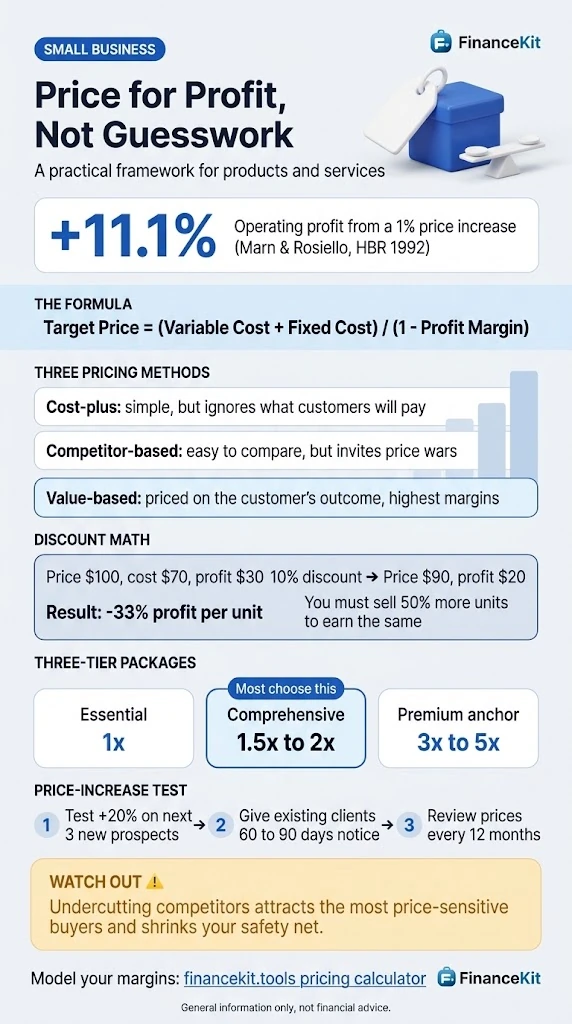
In landmark pricing research published in the Harvard Business Review, Michael V. Marn and Robert L. Rosiello (“Managing Price, Gaining Profit”, 1992) demonstrated that for an average company in their sample, a 1 percent price increase with sales volume held constant generated an 11.1 percent improvement in operating profit, far exceeding the impact of a 1 percent reduction in fixed or variable costs.
Pricing is not merely a mathematical tally of expenses; it is the single most powerful positioning statement your business makes. Here is a practical framework to calculate your costs, choose the right pricing methodology, and protect your profit margins.
Key takeaways
- Focus on fully loaded costs: Account for direct production, administrative overhead, marketing, taxes, and owner compensation.
- Ditch competitor-undercutting: Competing purely on price attracts the most price-sensitive customers while shrinking your financial safety net.
- Understand the difference between products and services: Physical goods require tracking Cost of Goods Sold (COGS) and inventory holding costs, while services require pricing limited labor capacity.
- Beware the math of discounting: A small price cut demands a massive increase in unit sales volume to maintain the same gross profit.
- Graduate to value-based pricing when possible: Anchor your fees to the economic return or transformation your customer experiences rather than internal inputs.
Products vs services: understanding your cost structure
Before selecting a pricing formula, you must account for the fundamental operational differences between selling physical goods and delivering professional services:
Pricing Physical Products
When pricing physical goods, your pricing floor is determined by Cost of Goods Sold (COGS) and inventory management:
- Direct Material and Manufacturing Costs: The raw materials, packaging, and assembly costs required to produce each unit.
- Shipping, Freight, and Customs: Inbound shipping to your warehouse plus outbound fulfillment and postage to the customer.
- Inventory Holding and Shrinkage Costs: Warehousing storage fees, insurance, spoilage, and unsold obsolescence.
- Wholesale and Retail Margins: If you sell through retail distribution or third-party stockists, retailers typically expect a 40 to 50 percent markup on wholesale prices (keystone pricing).
Pricing Professional Services
When pricing services, you are selling specialized expertise and limited time capacity:
- Billable Hours Reality: While a standard working year contains approximately 2,080 hours, a solo consultant or service professional rarely logs more than 1,000 to 1,200 billable client hours annually due to marketing, client proposals, invoicing, and admin.
- Fixed Overhead: Software subscriptions, professional indemnity insurance, accounting fees, and computing hardware.
- Taxes and Benefits: In the US, self-employed individuals must pay self-employment tax (Social Security and Medicare) and fund their own health coverage and retirement contributions out of gross client receipts.
Step 1: Calculate your true break-even floor
Before you can price for profit, you must understand your absolute survival baseline:
Target Price = (Unit Variable Cost + Allocated Fixed Cost) / (1 – Desired Profit Margin)
- Calculate Fixed Operating Costs: Sum all non-negotiable monthly business expenses (rent, software, insurance, bookkeeping, and minimum owner salary).
- Calculate Variable Unit Costs: Determine the direct cost incurred each time you make an additional sale (materials, transaction fees, packaging, or direct contractor labor).
- Determine Your Contribution Margin: Subtract variable costs from your selling price to find how much each unit contributes toward covering fixed overhead.
To determine your exact break-even volume and revenue threshold, test your numbers in our free break-even analysis calculator. You can also evaluate your per-unit profitability using our contribution margin calculator.
How to price a product: the three core pricing methodologies
Once your cost baseline is established, select an overarching pricing methodology:
| Methodology | Best For | Advantages | Primary Limitations |
|---|---|---|---|
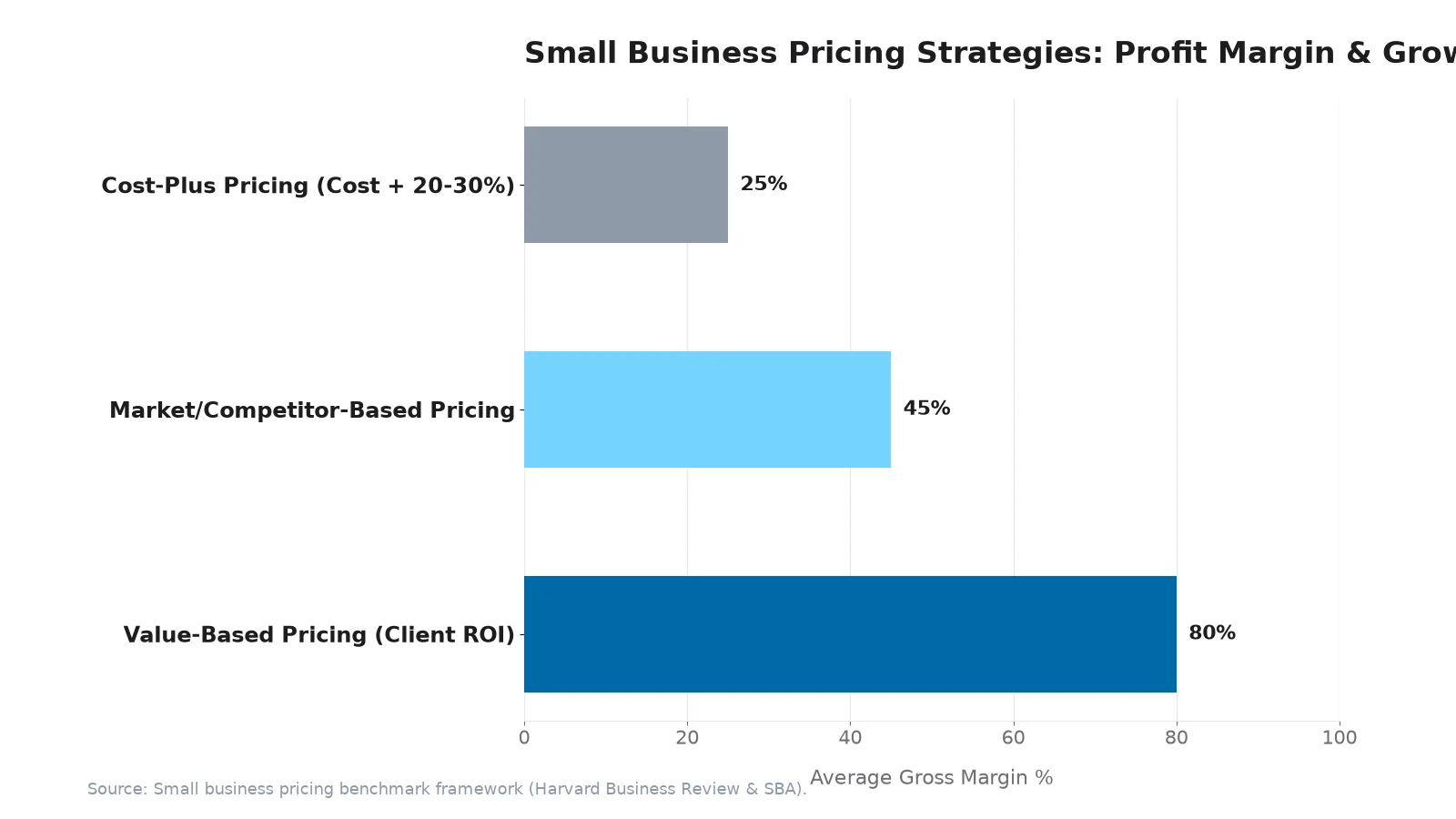
| **Cost-Plus Pricing** | Standard manufacturing, retail distribution, commodities | Simple to calculate; ensures direct production costs are covered | Ignores customer willingness to pay; can underprice highly differentiated products |
| **Competitor-Based Pricing** | Crowded markets, standard consumer goods | Aligns with market expectations; easy customer comparison | Encourages price wars; assumes competitors know their true costs |
| **Value-Based Pricing** | Bespoke services, specialized consulting, B2B software | Decouples earnings from production costs; maximizes profit margins | Requires deep discovery; difficult to standardize across entry-level offerings |
1. Cost-Plus Pricing (Input-Based)
You calculate total unit costs (materials plus labor and allocated overhead) and add a fixed markup percentage (for example, cost + 35 percent). – The flaw: Cost-plus pricing ignores customer perception. If you manufacture an innovative product that costs $20 to produce but solves a $500 problem for a corporation, adding a standard 30 percent markup to sell it at $26 forfeits immense profit potential.
2. Competitor-Based Pricing (Market-Based)
You benchmark your prices against prevailing market rates, positioning your business slightly below, level with, or slightly above market averages. – The flaw: Your competitors may have completely different overhead structures, rely on low-cost overseas labor, or be on the brink of insolvency. Never let an unprofitable competitor dictate your commercial model.
3. Value-Based Pricing (Outcome-Based)
You price based on the measurable economic impact, cost savings, or revenue increase that your solution creates for the customer. – The advantage: You capture the economic value of your expertise. A business strategy that takes twenty hours to prepare but generates $200,000 in new enterprise revenue is worth $20,000, not twenty hours of an hourly wage.
To model your wholesale markups, retail margins, and target selling prices across different tiers, use our free pricing calculator.
Understand the mathematical difference between markup and margin percentages before quoting by using our markup vs margin calculator.
How discounts eat your profit margins
Psychological Price Anchoring and Three-Tier Architecture
Buyer psychology is rarely absolute; customers perceive commercial value relative to contextual reference points. To avoid binary yes-or-no purchasing decisions, structure your pricing catalog around a three-tier architecture:
- Tier 1 (The Anchor / Premium Tier): Position your most comprehensive, all-inclusive solution at the highest price point (for example, $4,800). Even if only 10 to 15 percent of clients purchase this tier, its prominent presence establishes an elevated perception of capability and quality.
- Tier 2 (The Target / Core Tier): Position your ideal commercial offering directly beside the premium anchor at your target price point ($2,400). Compared to the anchor, the target tier appears exceptionally reasonable and represents high value for money.
- Tier 3 (The Foundation / Entry Tier): Offer a stripped-down, self-service, or limited-scope option ($950) designed to accommodate price-sensitive prospects without cannibalizing your core services.
Structuring offerings across three distinct tiers provides buyers with cognitive comparison within your ecosystem rather than driving them to compare your rates against outside competitors.
One of the most dangerous commercial habits among small businesses is offering quick discounts to close sales. Entrepreneurs often assume that a 10 percent discount is a minor concession. Mathematically, it can destroy your operating profit.
The Mathematics of Discounting
Consider a business selling a product for $100 with a 30 percent gross margin ($30 gross profit per unit, $70 unit cost):
- If you offer a 10 percent discount, the selling price becomes $90.
- Your unit cost remains $70, so your gross profit drops from $30 to $20 per unit, a 33.3 percent reduction in profit.
To calculate how much additional unit sales volume you must generate to make the exact same total dollar gross profit after a discount, apply this formula:
Target Price = (Unit Variable Cost + Allocated Fixed Cost) / (1 – Desired Profit Margin)
Target Price = (Unit Variable Cost + Allocated Fixed Cost) / (1 – Desired Profit Margin)
Offering a modest 10 percent discount requires you to sell 50 percent more units just to earn the same total gross profit dollars. Unless a discount unlocks massive operational economies of scale, discounting is almost always a path to financial exhaustion.
How to package your offering: tiered pricing
Human beings struggle to judge value in isolation; we assess value through comparison. When you present a prospective client with a single quote (such as “This project costs $5,000”), their decision is binary: “Yes or No.”
When you present three structured packages, the client’s decision shifts to: “Which option best fits our objectives?”
- Option 1 (The Essential): Solves the core problem with no added extras. Priced at your minimum profitable rate.
- Option 2 (The Comprehensive – Target Choice): Includes the core solution plus implementation support, enhanced deliverables, or priority delivery. Priced at 1.5x to 2x Option 1. This is where most customers naturally land.
- Option 3 (The Premium / Enterprise Anchor): High-touch, executive consulting, comprehensive licensing, and rapid turnaround. Priced at 3x to 5x Option 1. Even if rarely purchased, it anchors high value and makes Option 2 appear balanced and compelling.
Test and adjust: implementing price increases
Pricing is not a permanent decision set in stone; it is an ongoing commercial hypothesis that requires regular testing and calibration:
- Test higher rates on new inquiries: Never raise prices across all existing clients simultaneously. Test a 20 percent higher price on your next three prospective clients. If all three accept immediately without negotiation, your rates are still below market equilibrium.
- Grandfather existing clients gracefully: Give long-standing clients 60 to 90 days advance written notice before adjusting rates, explaining the increase in the context of expanded capabilities, rising operational investments, and the proven outcomes you deliver.
- Review prices annually: Schedule a formal pricing audit every twelve months to adjust for general inflation, increased software costs, and expanded expertise.
To see how to manage incoming freelance cash flow and separate operating accounts, consult our foundational guide on how to manage your money.
Frequently asked questions
Should I publish prices publicly on my website?
For standardized products, software subscriptions, or packaged service tiers, transparent pricing qualifies prospective leads and eliminates customers who cannot afford your baseline. For bespoke, high-ticket consulting, publishing “Engagements starting from [X] dollars” sets a quality floor while preserving the ability to price according to project scope.
What should I do when a prospect says “You are too expensive”?
Never apologize or offer an immediate across-the-board discount. A spontaneous discount signals that your original quote was inflated. Instead, offer to adjust the scope of work: “We can certainly meet your $3,500 budget by removing deliverable C and extending the completion timeline. Would you like to proceed with that modified scope?”
How do I transition an hourly service business to value-based pricing?
Start by packaging your most frequent services into fixed-scope outcomes with defined deliverables. Once you understand the business value of that outcome to the client, quote a flat project fee that reflects the outcome rather than multiplying hours by an hourly rate.
The one next step
Review your product line or service packages today. Calculate your true gross profit margin on your most popular offering. If that margin is below 30 percent, model a 15 percent price increase on your next proposal to protect your cash reserves.
Sources
Fact-checked on September 28, 2026 against the sources below.
- Marn, Michael V. and Rosiello, Robert L.: Managing Price, Gaining Profit (Harvard Business Review, September-October 1992). https://hbr.org/1992/09/managing-price-gaining-profit
- Nagle, Thomas T. and Müller, Georg: The Strategy and Tactics of Pricing: A Guide to Growing More Profitably (Routledge, 6th Edition).
- OECD: SME and Entrepreneurship Outlook – Competitiveness, productivity, and pricing power in small business. https://www.oecd.org/industry/smes/
- Small Business Administration (SBA): Pricing Products and Services – Financial Management for Small Businesses. https://www.sba.gov/business-guide/manage-your-business/manage-your-finances
This article is for general information only and is not financial, tax or legal advice. Rules and rates change; check the official sources listed above or speak to a qualified adviser before making a decision.