
Retirement Planning by Age: What to Do in Your 20s, 30s, 40s and 50s
Retirement planning by age made practical. Track savings milestones for your 20s, 30s, 40s, and 50s, catch-up contributions, and pension benchmarks.


Retirement planning frequently suffers from two opposite psychological traps. In your twenties and thirties, retirement feels so impossibly distant that setting money aside feels like a low priority compared to rent, student loans, or travel. In your forties and fifties, the realization that retirement is around the corner can trigger panic, leading people to either take reckless investment risks or give up entirely.
Both traps can be avoided with a clear, decade-by-decade strategy. Successful retirement planning by age is not about hitting impossible targets; it is about taking the specific, high-leverage actions that fit each stage of your working life.
According to data from the Social Security Administration (SSA), Social Security benefits replace approximately 40 percent of pre-retirement earnings for an average wage earner in the United States. That means you are responsible for funding the remaining 60 percent of your lifestyle through personal savings, workplace retirement plans, and private pensions.
Here is the decade-by-decade roadmap to build, grow, and protect your retirement nest egg.
Key takeaways
- In your 20s, time is your greatest asset; capturing your full employer match and automating 10 to 15 percent of your income creates massive compounding growth.
- In your 30s, balance homebuying and childcare costs with automated investing; save at least half of every pay raise to keep savings expanding.
- In your 40s, your peak earning years begin; eliminate consumer debt and review your asset allocation as retirement approaches.
- In your 50s, take advantage of statutory catch-up contribution limits and obtain an official state pension or Social Security forecast.
- Use Fidelity’s savings milestones as a rule of thumb, recognizing that individual career paths and family situations vary.
Why the decade matters in retirement planning
The arithmetic of compounding means that dollars saved early in your career work far harder than dollars saved later.
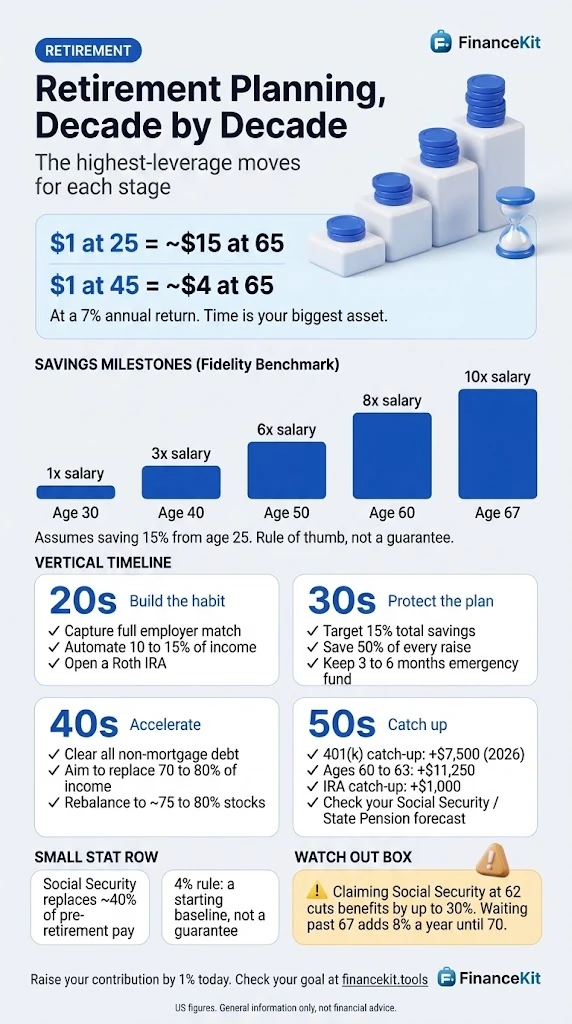
A dollar invested at age 25 at a 7 percent annualized nominal return grows to approximately $15 by age 65. That same dollar invested at age 45 grows to only $4 by age 65. In your twenties, your primary advantage is time. In your fifties, your primary advantage is income and contribution capacity. Aligning your strategy with your decade ensures you maximize whichever advantage you hold today.
Retirement planning by age: savings milestones and limits
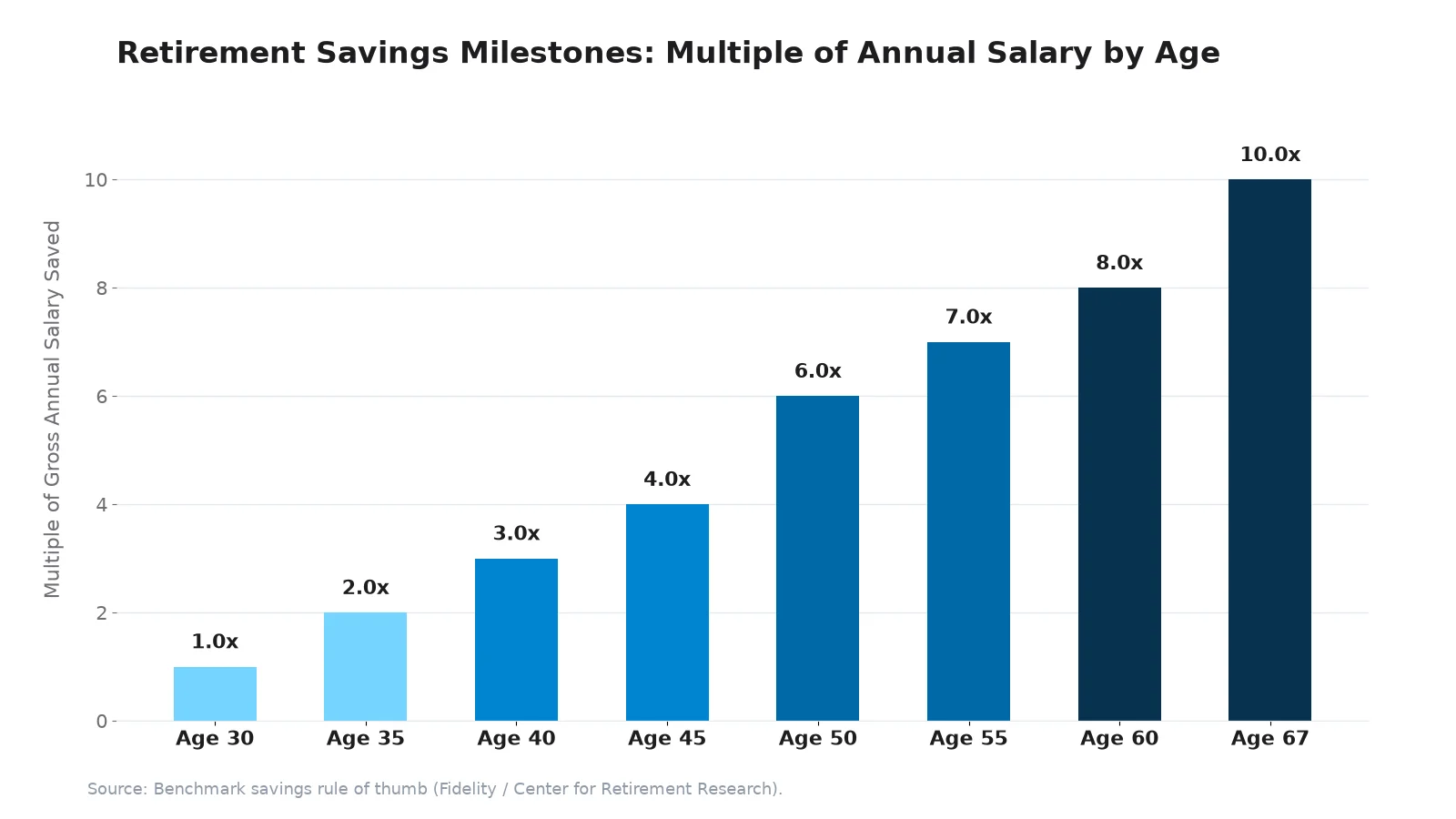
A widely recognized framework developed by Fidelity Investments provides savings benchmarks expressed as multiples of your gross annual salary, assuming an individual saves 15 percent of income annually starting at age 25 and plans to retire at age 67:
| Age Milestone | Recommended Savings Multiple | Example ($60,000 Salary) | Example ($100,000 Salary) | Core Focus for the Decade |
|---|---|---|---|---|
| **Age 30** | 1x annual salary | $60,000 | $100,000 | Establish automated saving habit |
| **Age 40** | 3x annual salary | $180,000 | $300,000 | Protect savings from lifestyle creep |
| **Age 50** | 6x annual salary | $360,000 | $600,000 | Maximize peak earnings and catch-ups |
| **Age 60** | 8x annual salary | $480,000 | $800,000 | Shift toward capital preservation |
| **Age 67** | 10x annual salary | $600,000 | $1,000,000 | Sustainable distribution phase |
The limits of salary multiples
These benchmarks are useful rules of thumb, but they have distinct limitations:
- Income trajectory differences: If your salary jumped significantly from $50,000 to $120,000 in your late thirties, your savings multiple will temporarily look low even if your total savings are strong.
- Cost of living variations: Someone retiring in an area with paid-off housing and low property taxes requires a smaller multiple than someone renting in an expensive city.
- Alternative pensions: These multiples assume you rely primarily on personal defined-contribution accounts (like a 401k). If you have a defined-benefit pension, your required personal multiple is substantially lower.
To see whether your current trajectory is on track to meet your retirement goals, test your numbers in our free retirement savings calculator.
In your 20s: Establish the habit and capture the match
In your twenties, your greatest enemy is waiting to start. You do not need large sums of money to begin building wealth.
Key actions for your 20s:
- Capture your full employer 401(k) match: This is free money from your employer. If your company offers a 50 percent match on contributions up to 6 percent of salary, that represents an instant 50 percent return on your money.
- Open a Roth IRA: Fund a Roth IRA with post-tax dollars. Your investments grow tax-free, and qualified withdrawals after age 59½ are completely exempt from federal income tax.
- Adopt a growth-oriented asset allocation: Industry target-date retirement funds designed for individuals in their twenties typically allocate 85 to 90 percent of assets to diversified global equities and 10 to 15 percent to bonds, maximizing long-term compounding.
- Avoid consumer debt: Stay clear of credit card balances and high-interest car loans, which siphon away your most valuable compounding dollars.
You can model the growth of regular retirement deposits over multiple decades with our retirement contribution growth calculator.
In your 30s: Balance competing priorities and expand contributions
Your thirties are often the most financially complex decade of life. Home purchases, weddings, childcare, and career relocations compete aggressively with retirement savings.
Key actions for your 30s:
- Target 15 percent total savings: Aim to save 15 percent of your gross income across workplace retirement plans and individual accounts (including any employer match).
- Apply the 50 percent raise rule: Whenever you receive a salary bump or annual bonus, allocate at least 50 percent of the net increase toward retirement and savings before upgrading your lifestyle.
- Keep an adequate emergency fund: Maintain three to six months of essential living expenses in an accessible high-yield savings account so a temporary job interruption does not force you to tap your retirement accounts.
- Resist pulling money from retirement for a down payment: While some retirement rules allow penalty-free withdrawals for first-time home purchases, taking money out of compounding accounts permanently reduces your long-term nest egg.
To compare how different savings contributions affect your retirement readiness, review our guide on how to manage your money.
In your 40s: Accelerate savings during peak earning years
In your forties, your career experience typically translates into higher compensation. However, retirement is now fifteen to twenty years away, meaning you have less time to recover from extended market downturns.
Key actions for your 40s:
- Assess your progress with realistic modeling: Review your total accumulated balance against your target retirement spending. Most financial planners recommend aiming to replace 70 to 80 percent of your pre-retirement income to maintain your current lifestyle in retirement.
- Eliminate non-mortgage debt permanently: Pay off any remaining auto loans, home equity lines of credit, or personal loans so your monthly expenses decrease before retirement.
- Gradually rebalance portfolio risk: Target-date fund glide paths for individuals in their forties typically adjust equity allocations to approximately 75 to 80 percent, with 20 to 25 percent in fixed income and bonds to moderate portfolio volatility.
- Evaluate long-term healthcare needs: Start researching how healthcare costs will be handled between potential early retirement and Medicare eligibility at age 65.
To calculate your target nest egg based on your anticipated retirement spending, use our required nest egg calculator.
In your 50s: Maximize catch-up contributions and plan distribution
Phased Retirement and Healthcare Transition in Your 60s
The transition from full-time professional employment into complete retirement has evolved from an abrupt cliff into a gradual phased process. Modern retirees increasingly leverage fractional advisory or consulting arrangements to bridge the income gap between ages 60 and 67.
Managing this multi-year glide path effectively requires deliberate structural planning: 1. Bridging Pre-Medicare Healthcare Costs: In the United States, departing corporate employment before age 65 creates a private health insurance funding requirement. Budget for ACA marketplace silver-tier benchmark policies or COBRA continuation before finalizing early retirement dates. 2. Optimizing Statutory Pension Claims: Claiming state pensions or Social Security at the earliest eligibility age (such as age 62 in the US) permanently locks in an actuarial reduction of up to 30 percent compared to waiting for full retirement age (age 67). Delaying benefits until age 70 generates guaranteed delayed retirement credits of 8 percent annually. 3. Roth Conversion Ladders: Between formal career exit and mandatory required minimum distribution (RMD) ages, execute targeted annual Roth conversions during lower marginal tax rate brackets, shielding future distribution streams from elevated income tax tiers.
Your fifties are the decade of precision planning. Children often become financially independent, college tuition payments conclude, and your focus shifts toward transition logistics.
Key actions for your 50s:
- Utilize US statutory catch-up contribution limits: – Under IRS rules for 2026, workers aged 50 and older can contribute an additional $7,500 in catch-up contributions to their 401(k), 403(b), or 457 plans beyond standard annual limits. – Under SECURE 2.0 legislation, a higher catch-up limit of $11,250 applies to individuals aged 60, 61, 62, and 63. Note that under SECURE 2.0 rules, catch-up contributions for employees earning over statutory wage thresholds must be made on a Roth (post-tax) basis. – IRA catch-up contributions allow an additional $1,000 annually for individuals aged 50 and older.
- Check your state pension or Social Security forecast: – In the United States: Create an account at
ssa.gov/myaccountto view your personalized Social Security Statement. Check your reported earnings history for errors and view your estimated monthly benefits at age 62, Full Retirement Age (between 66 and 67), and age 70. – In the United Kingdom: Use the “Check your State Pension forecast” tool on GOV.UK to review your National Insurance qualifying years and projected weekly state pension amount. - Understand safe withdrawal rates: – Financial planner William Bengen’s classic 1994 study in the Journal of Financial Planning introduced the “4 percent rule,” showing that a portfolio of 50 percent US stocks and 50 percent intermediate bonds historically supported a 4 percent initial withdrawal (adjusted annually for inflation) over a 30-year retirement without running out of money. – Bengen’s research was based on US historical market data; international historical returns have occasionally experienced lower safe withdrawal rates. Treat 4 percent as a starting planning baseline rather than a guaranteed rule.
To identify any gap between your projected savings and your retirement income needs, calculate your position with our retirement shortfall calculator.
Frequently asked questions
What should I do if I am 40 with zero retirement savings?
Do not despair, but act with urgency. At age 40, you still have 25 to 27 working years until traditional retirement. By saving and investing 20 to 25 percent of your gross income into diversified low-cost index funds, you can build a substantial retirement fund. Focus aggressively on avoiding lifestyle inflation, capturing all employer matches, and controlling housing costs.
What is Full Retirement Age for Social Security?
In the United States, Full Retirement Age (FRA) is 67 for anyone born in 1960 or later. While you can claim benefits as early as age 62, doing so permanently reduces your monthly payout by up to 30 percent. Delaying your claim past FRA earns delayed retirement credits of 8 percent per year up to age 70.
Should I pay off my mortgage before retiring?
Entering retirement with no mortgage payment drastically reduces your monthly fixed living costs, lowering the withdrawal rate required from your investment portfolio. However, if your mortgage carries a very low fixed interest rate (such as 3 percent), maintaining adequate liquid cash reserves in high-yield savings may provide greater financial flexibility than locking all your cash into home equity.
How much income do I really need in retirement?
A common financial planning benchmark suggests aiming to replace 70 to 80 percent of your pre-retirement gross income. This reduction accounts for the fact that retirees no longer pay payroll taxes, no longer save 15 percent of their pay for retirement, and often have paid off mortgages.
The one next step
Log into your workplace retirement plan or primary investment brokerage today. Increase your automatic contribution rate by exactly 1 percent. For someone earning $60,000 per year, a 1 percent increase represents just $50 per month before taxes, but compounded over twenty years, that single change adds tens of thousands of dollars to your retirement security.
Sources
Fact-checked on September 28, 2026 against the sources below.
- Fidelity Investments: How Much Money Do I Need to Retire? (Retirement Savings Milestones by Age). https://www.fidelity.com/viewpoints/retirement/how-much-money-should-I-save
- Social Security Administration (SSA): Social Security Benefit Calculations and Replacement Rates. https://www.ssa.gov/oact/quickcalc/
- Internal Revenue Service (IRS): Retirement Topics – Catch-Up Contributions and SECURE 2.0 Act provisions. https://www.irs.gov/retirement-plans/plan-participant-employee/retirement-topics-catch-up-contributions
- Bengen, William P.: Determining Withdrawal Rates Using Historical Data (Journal of Financial Planning, Vol. 7, No. 4, October 1994).
- HM Revenue & Customs / DWP: Check your State Pension forecast on GOV.UK. https://www.gov.uk/check-state-pension
This article is for general information only and is not financial, tax or legal advice. Rules and rates change; check the official sources listed above or speak to a qualified adviser before making a decision.