
How to Start Investing With Little Money: A Beginner’s Roadmap
Master how to start investing even with small amounts. Compare global index ETFs, understand compounding returns, and choose the right tax wrappers.


One of the most persistent financial myths is that investing is reserved exclusively for the wealthy. Many people believe they need ten thousand dollars in cash, a finance degree, or hours spent analyzing stock charts before they can participate in the stock market.
The reality is that modern financial technology has dismantled these barriers. Today, fractional shares, zero-commission brokerages, and low-cost index funds mean anyone can learn how to start investing with as little as twenty or fifty dollars.
According to the UBS Global Investment Returns Yearbook (covering data from 1900 to 2023), global equities have delivered an annualized real return of approximately 5.1 percent after adjusting for inflation (with US equities averaging roughly 6.5 percent real). While returns fluctuate significantly in the short term, patient investors who hold diversified assets over decades build substantial purchasing power.
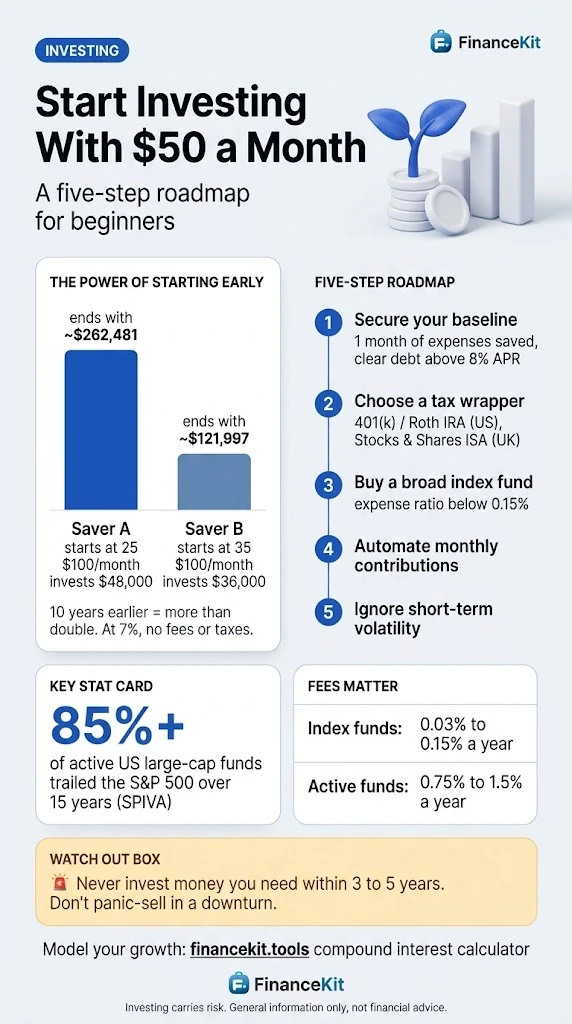
Here is the five-step roadmap to start investing with small amounts of money:
- Secure your financial baseline. Establish a starter cash buffer of one month of essential expenses and clear high-interest consumer debt above 8 percent APR.
- Choose the right account wrapper. Utilize tax-sheltered retirement accounts such as a 401k or Roth IRA in the US, or a Stocks & Shares ISA in the UK.
- Select a low-cost, broad-market index fund. Buy global or total stock market index funds with annual expense ratios below 0.15 percent.
- Automate recurring monthly contributions. Set up an automated monthly transfer so your investment happens automatically every payday.
- Ignore short-term volatility. Stay invested through market cycles and avoid panic selling during normal economic downturns.
Key takeaways
- Investing a small amount every month beats waiting years to build a large lump sum.
- Clear high-interest debt above about 8 percent APR before investing beyond an employer retirement match.
- Broad-market index funds outperform the vast majority of actively managed mutual funds over long periods.
- Watch investment friction: high expense ratios, trading fees, and platform platform charges quietly erode your returns.
- Diversify globally rather than betting on single companies, trending sectors, or speculative assets.
- Markets carry genuine volatility and risk; time horizon and emotional discipline are your greatest protections.
How to start investing: the foundation checklist
Before purchasing your first investment, you must protect your day-to-day living situation:
1. The Starter Cash Buffer
Keep at least one month of basic living expenses (about $1,000) in an accessible high-yield savings account. If an unexpected expense occurs, this buffer prevents you from having to sell your newly purchased investments at a loss.
2. High-Interest Debt Elimination
If you carry credit card balances or personal loans charging 15 to 25 percent APR, paying off that debt is mathematically guaranteed to deliver a higher return than the stock market. Clear all consumer debt above about 8 percent APR first, as detailed in our guide on how to get out of debt.
3. Capture Free Employer Matching Funds
The one exception to pausing investing while paying down debt is an employer retirement match. If your employer offers a 401k or workplace pension match (such as a 50 percent match on contributions up to 6 percent of salary), contribute enough to capture that full match immediately. This is free money from your employer and provides an immediate 50 percent return on your contributed funds.
How much and how often: the power of small sums
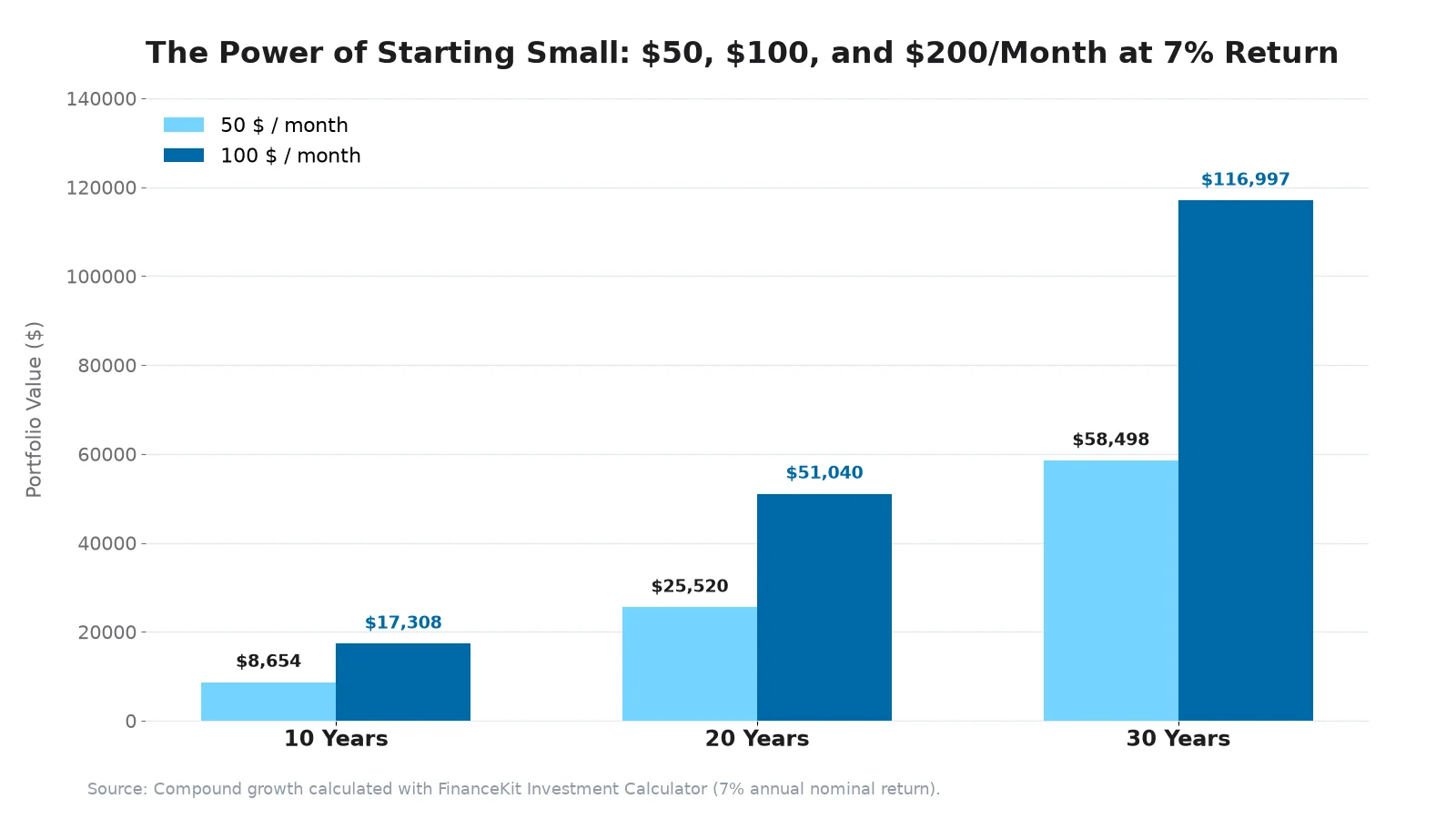
You do not need hundreds of dollars to begin. Consistently investing $50 or $100 per month establishes the habit of wealth building while your career grows.
Dollar-cost averaging is the practice of investing a fixed dollar amount into the market at regular intervals, regardless of whether prices are rising or falling. While financial studies (such as Vanguard’s historical analysis of lump-sum vs dollar-cost averaging) find that investing a lump sum immediately outperforms spreading it out in roughly two-thirds of historical periods, beginners rarely have a large lump sum available. For regular earners, investing a set amount each month from current income is the most practical way to build wealth.
To see the mathematical impact of investing small sums consistently over time, consider the comparison between two savers investing at a 7 percent annualized nominal return with monthly compounding (assumptions: monthly contributions, 7% nominal return, no platform fees, and no taxes):
- Saver A begins at age 25, investing $100 every month. By age 65, Saver A has contributed $48,000 out of pocket and accumulated approximately $262,481.
- Saver B waits until age 35 to begin, investing $100 every month. By age 65, Saver B has contributed $36,000 out of pocket and accumulated approximately $121,997.
By starting ten years earlier, Saver A invested just $12,000 more in total contributions, but finished with more than double the final wealth due to compounding time.
Model your own regular contributions with our dollar-cost averaging calculator or simulate long-term wealth growth with our compound interest with contributions calculator.
Accounts and wrappers in your country
Where you hold your investments matters almost as much as what you buy. Tax-sheltered accounts protect your dividends and capital gains from annual taxation:
In the United States:
- 401(k) / 403(b): Workplace retirement accounts funded directly from your paycheck. Traditional accounts offer upfront tax deductions, while Roth 401(k) accounts use post-tax dollars for tax-free withdrawals in retirement.
- Roth IRA: An individual retirement account funded with post-tax dollars. Investment growth and qualified withdrawals after age 59½ (provided the account has been open at least five years) are 100 percent tax-free. Note that annual contribution limits and income phaseout limits apply under IRS rules.
- Standard Taxable Brokerage: An account with no contribution limits, but dividends and realized capital gains are subject to annual taxes.
In the United Kingdom:
- Stocks & Shares ISA (Individual Savings Account): Allows UK residents aged 18 and over to invest up to statutory annual allowances (£20,000) completely free of UK capital gains tax and dividend tax.
- Self-Invested Personal Pension (SIPP): A personal pension offering tax relief on contributions, locked until minimum pension age.
What to buy: index funds vs active trading
Comprehensive Index Fund Selection Criteria
When choosing an index tracker for your core portfolio, evaluate prospective ETFs across four technical dimensions:
- Total Expense Ratio (TER): Seek broad-market ETFs with annual management expense ratios below 0.15 percent. A seemingly tiny difference of 0.30 percent in annual fees drains tens of thousands of dollars from your accumulated portfolio over a thirty-year horizon.
- Tracking Difference and Replication Method: Prefer physically replicated funds that hold the actual underlying equities rather than synthetic derivative structures. Examine the five-year tracking difference: top-tier funds often track their benchmark indices with less than 0.05 percent tracking error.
- Fund Size and Liquidity: Target established funds with assets under management (AUM) exceeding $500 million. Larger fund volumes ensure tight bid-ask spreads during trading hours and reduce the liquidation risk of fund closure.
- Fund Domicile and Withholding Taxes: For European and UK investors, choosing UCITS ETFs domiciled in Ireland or Luxembourg optimizes international dividend withholding tax treaties compared to directly holding US-domiciled equity funds.
By automating consistent monthly orders into two or three foundational funds, you capture global economic growth while eliminating individual company default risk.
When learning how to start investing, many beginners gravitate toward picking individual stocks, buying trending tech companies, or trading volatile options.
Data demonstrates that trying to outguess the market is a losing strategy for most investors. According to the SPIVA U.S. Scorecard (published by S&P Dow Jones Indices), over 85 percent of actively managed US large-cap equity funds underperformed the S&P 500 index over a 15-year investment period. If full-time professional fund managers with teams of analysts fail to beat the market, retail beginners should not expect to do so consistently.
The Index Fund Advantage
An index fund simply buys and holds every company in a market benchmark (such as the S&P 500 or the FTSE All-World). When you buy a share of a global index fund:
- You own a fractional stake in thousands of companies across multiple countries and industries.
- If a single company encounters bankruptcy, it represents a tiny fraction of your portfolio and cannot destroy your savings.
- Management fees are minimal because no expensive analysts are being paid to trade stocks.
To explore how diversified asset classes fit together in a balanced portfolio, test your allocations in our portfolio allocation calculator.
Costs to watch: the silent killers of wealth
Investment expenses act like a drag on your portfolio. Even small percentages compound over decades into tens of thousands of dollars in lost returns:
- Expense Ratios (Fund Fees): The annual percentage deducted by the fund manager to run the fund. Excellent index funds carry expense ratios between 0.03 and 0.15 percent ($3 to $15 per year per $10,000 invested). Actively managed funds often charge 0.75 to 1.5 percent, which severely erodes compounding growth.
- Platform and Custody Fees: The fee charged by the brokerage to hold your investments. Look for low-cost brokerages that charge zero account custody fees or a flat nominal fee.
- FX and Currency Conversion Spreads: If you buy foreign-listed ETFs, check the brokerage’s foreign exchange markup, which can take 0.5 to 1.5 percent off every transaction.
You can calculate the exact dollar impact of different fund fee tiers over your career with our expense ratio impact calculator.
Managing risk: understanding market volatility
All stock market investing carries risk. Share prices fluctuate continuously based on economic data, corporate earnings, interest rate shifts, and geopolitical events.
It is critical to recognize that market recoveries are not guaranteed to happen overnight. While the US stock market has historically recovered from downturns over multi-year horizons, historical international examples illustrate the importance of a long time horizon:
- Japan’s Nikkei 225 stock index peaked in December 1989 and did not regain that nominal level until February 2024, approximately 34 years later.
- Diversification across global markets, rather than concentrating all capital in a single country or sector, reduces the risk of prolonged regional stagnation.
Never invest money in the stock market that you anticipate needing within the next three to five years. Short-term funds belong in high-yield savings accounts or fixed-term deposits where nominal principal is protected.
Beginner mistakes to avoid
Avoid these common traps when starting your investment journey:
- Checking your portfolio daily: Daily price fluctuations trigger emotional reactions. Set your automated transfer and check your accounts quarterly or semi-annually.
- Panic selling during downturns: Market corrections (drops of 10 to 20 percent) occur regularly. Selling during a downturn locks in temporary paper losses and ensures you miss the eventual recovery.
- Chasing past performance: Buying whatever asset went up 50 percent last year often means purchasing at peak valuation right before a correction.
- Failing to increase contributions with pay raises: As your income grows, increase your monthly investment contributions by saving at least half of every raise.
Frequently asked questions
Can I lose all my money investing in index funds?
For a broad global index fund to go to zero, every major publicly traded company in the world would have to become worthless simultaneously, an event that would represent total global economic collapse. However, index funds can and do drop in value during market downturns (sometimes by 20 to 40 percent in severe recessions). Your losses remain unrealized paper drops unless you sell during the decline.
What is the difference between an ETF and a mutual fund?
An Exchange-Traded Fund (ETF) trades on stock exchanges like an individual stock throughout the trading day. An index mutual fund prices once per day after markets close. For most beginners, both serve the same functional purpose of providing low-cost index diversification.
Should I invest while still paying off student loans?
If your student loan carries an interest rate below 4 to 5 percent, investing surplus income in diversified index funds historically outpaces that cost over decades. However, if your student loan rate exceeds about 8 percent APR, paying off the debt provides a guaranteed, risk-free financial return. Always capture your full employer retirement match regardless of student debt.
How do dividends work?
When profitable companies distribute a portion of their earnings to shareholders, these payments are called dividends. As a beginner, set your investment account to automatically reinvest all dividends (often called DRIP). Reinvesting dividends automatically purchases more fractional shares, accelerating your compounding growth.
The one next step
Open an account with a reputable, low-cost investment brokerage today. Complete the identity verification and set up an automated transfer of $50 from your next paycheck into a broad-market index fund. Taking that first small action turns you from a bystander into a long-term investor.
Sources
Fact-checked on September 28, 2026 against the sources below.
- UBS: Global Investment Returns Yearbook (historical analysis of long-run real equity returns, 1900-2023). https://www.ubs.com/global/en/wealth-management/insights/global-investment-returns-yearbook.html
- S&P Dow Jones Indices: SPIVA U.S. Scorecard (Year-End 2023 and Mid-Year 2024 active vs passive manager performance). https://www.spglobal.com/spdji/en/research-insights/spiva/
- Vanguard: Here’s Why Dollar-Cost Averaging Rarely Beats Lump-Sum Investing (Research on cost averaging vs immediate investment). https://corporate.vanguard.com/content/corporatesite/us/en/corp/articles/case-for-low-cost-index-fund-investing.html
- Internal Revenue Service (IRS): Retirement Topics – IRA Contribution Limits and Roth IRA Income Limits. https://www.irs.gov/retirement-plans/plan-participant-employee/retirement-topics-ira-contribution-limits
- Financial Conduct Authority (FCA) & HM Revenue & Customs: Individual Savings Accounts (ISAs) guidelines and rules on GOV.UK. https://www.gov.uk/individual-savings-accounts
This article is for general information only and is not financial, tax or legal advice. Rules and rates change; check the official sources listed above or speak to a qualified adviser before making a decision.