
How to Save for a Big Purchase Without Taking Debt
Wondering how to save for a big purchase without high-interest loans? Master the sinking fund strategy to pay cash for cars, weddings, and trips.

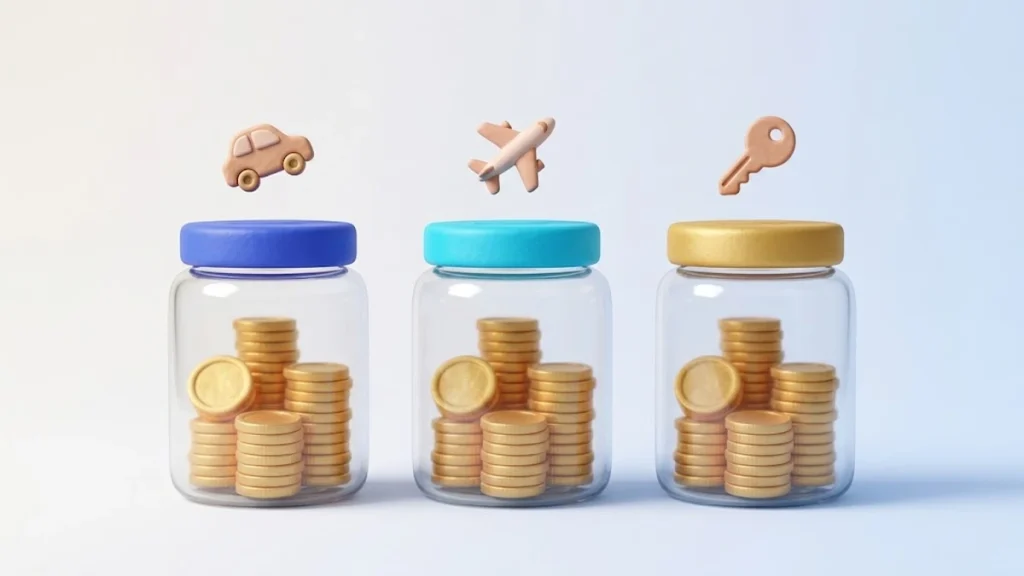
Figuring out how to save for a big purchase starts with accepting that the target can feel overwhelming at first. Whether you are aiming to buy a dependable pre-owned vehicle, finance a major home renovation, pay cash for a dream wedding, or upgrade vital professional equipment, five-figure expenses demand a structured, disciplined methodology. Relying on casual leftover money at the end of the month almost always results in frustration, missed deadlines, or worse, succumbing to costly consumer debt that erodes your long-term wealth.
The secret to funding large lifestyle goals without financial stress lies in transforming an intimidating lump-sum milestone into predictable, bite-sized monthly obligations. By establishing dedicated sinking funds, securing your capital in yield-bearing insured accounts, and automating your banking infrastructure, you completely eliminate the anxiety of major outlays. Instead of paying interest to lenders for years after an acquisition, you capture interest payments for yourself while you accumulate capital.
Before allocating funds, you must determine your exact monthly target based on your total planned expenditure, your timeline, and the yield generated by your savings vehicle.
1. Sinking Funds vs Emergency Funds: The Fundamental Distinction
A common error that derails personal financial plans is mingling project savings with an emergency fund. These two cash reserves serve diametrically opposed functions in your balance sheet, and commingling them compromises your financial security.
An emergency fund is designed exclusively for unplanned, non-negotiable financial shocks: sudden job loss, unexpected medical crises, or urgent structural repairs. It acts as pure capital preservation insurance. You never plan when or how to spend your emergency fund, and you hope never to touch it.
Conversely, a sinking fund is an intentional, proactive reserve created for a specific, anticipated expense with an identifiable price tag and a defined target date. Sinking funds are designed to be spent down to zero when the purchase occurs. By maintaining distinct accounts or digital sub-buckets for separate objectives, you protect your baseline emergency cushion from accidental depletion.
| Feature | Emergency Fund | Sinking Fund |
|---|---|---|
| Purpose | Unplanned catastrophes and income disruption | Planned, specific capital expenditures |
| Target Date | Indefinite (held permanently in reserve) | Fixed deadline (e.g., 6, 12, or 24 months) |
| Spending Outcome | Spent only during urgent crises | Spent down to zero upon project execution |
| Account Structure | Single, dedicated high-yield liquid account | Multiple dedicated accounts or named sub-buckets |
2. The true cost of debt vs cash
To understand the immense financial leverage of saving for a big purchase in advance, you must evaluate the mathematical penalty of debt financing. When consumers purchase a $15,000 automobile or $10,000 home remodeling project using unsecured personal loans, credit card balances, or point-of-sale financing, the headline sticker price represents only a fraction of the total cash drained from their household.
Consider a $12,000 purchase financed over 36 months using a standard unsecured personal loan at an interest rate of 11.5 percent versus saving that same amount in advance within a high-yield savings account yielding 4.25 percent annual percentage yield (APY):
| Strategy | Monthly Cash Flow Impact | Total Interest Paid / Earned | Net Real Cost of the Purchase |
|---|---|---|---|
| Personal Loan (36 mo @ 11.5%) | -$395.73 per month | -$2,246.28 (Paid to bank) | $14,246.28 |
| Sinking Fund (36 mo @ 4.25% APY) | +$313.12 per month | +$727.68 (Earned interest) | $11,272.32 |
| Net Difference | $82.61 saved monthly | +$2,973.96 in your pocket | $2,973.96 cheaper in cash |
The mathematical gap between borrowing and saving in advance exceeds $2,970 on a modest $12,000 project. Financing forces you to pay over $14,200 for a $12,000 item. In sharp contrast, a disciplined sinking fund reduces your net out-of-pocket expenditure to $11,272 because compound interest works in your favor rather than enriching a commercial lender.
3. Where to Park Your Sinking Funds: Security and Yield
Because big purchase savings have fixed timelines ranging from several months to three years, capital preservation is non-negotiable. You should never invest short-term sinking funds in volatile equity markets or speculative assets. A 15 percent stock market pullback right before your vehicle down payment or wedding vendor deadline creates acute financial distress.
The optimal vehicles for holding big purchase reserves prioritize liquidity and federal deposit protection:
1. High-Yield Savings Accounts (HYSAs): Modern digital banks and reputable financial institutions offer high-yield accounts paying competitive interest rates with zero monthly maintenance fees. Ensure your deposits are held at an institution insured by the Federal Deposit Insurance Corporation (FDIC) or National Credit Union Administration (NCUA), guaranteeing principal protection up to $250,000 per depositor, per insured institution.
2. Certificates of Deposit (CDs): If your purchase date is immutably fixed (for example, a balloon lease buyout occurring exactly 18 months from today), locking portions of your capital into a fixed-rate CD guarantees your yield regardless of macroeconomic interest rate fluctuations.
3. Short-Term Treasury Bills: For substantial five-figure targets, buying 4-week, 13-week, or 26-week U.S. Treasury bills directly via TreasuryDirect provides sovereign safety while exempting the earned yield from state and local income taxes.
4. Step-by-Step Architecture for Your Savings Goal
To construct a dependable savings mechanism that operates without relying on daily willpower, implement this four-phase architectural framework:
Phase 1: Define the All-Inclusive Target Price: Avoid estimating the sticker price alone. Every major purchase brings auxiliary costs. When purchasing a vehicle, factor in sales taxes, registration fees, initial documentation costs, and insurance adjustments. For home renovations, add a mandatory 15 to 20 percent contingency buffer to absorb contractor cost overruns and structural surprises.
Phase 2: Calculate the Exact Monthly Allocation: Divide your comprehensive target amount by the number of months remaining until your planned purchase date. For example, if you require $9,000 in 18 months, your baseline contribution is exactly $500 per month. If compounding interest yields approximately $20 per month, treat that extra interest as a built-in safety cushion.
Phase 3: Establish Sub-Accounts with Goal Naming: Behavioral finance research demonstrates that money designated for a vivid, specific goal is significantly less likely to be raided for impulsive consumer spending. Utilize banks that offer digital “sub-accounts” or “vaults” and label them clearly: “2027 Car Replacement” or “Kitchen Remodel Cash”.
Phase 4: Automate Payroll and Banking Transfers: Remove human friction entirely. Schedule automated recurring transfers from your primary checking account into your designated sinking fund account to execute the morning after your monthly or bi-weekly paycheck lands. By paying your goal first, you force your lifestyle to adapt to the remaining balance.
5. Budget Restructuring: Accelerating Your Timeline
If your baseline monthly calculation reveals that your target timeline requires more cash than your current disposable income allows, you have two strategic levers: extend the timeline or accelerate your cash flow.
To accelerate your timeline without enduring permanent lifestyle misery, implement temporary, targeted spending freezes on elastic budget categories:
1. Audit Recurring Subscriptions: Conduct a line-by-line review of bank statements over the past 90 days. Cancel dormant streaming memberships, unused gym access, software apps, and recurring delivery services. Reclaiming $120 per month adds over $1,400 directly to your project within a single year.
2. Channel Windfalls and Variable Income: Direct 100 percent of unexpected capital injections directly into your sinking fund. Annual performance bonuses, tax refunds, overtime pay, and cash gifts should bypass discretionary spending entirely.
3. Monetize Dormant Household Assets: Most households hold thousands of dollars in unused electronics, sports gear, designer apparel, and tools. Selling unneeded personal property on secondary marketplaces generates an immediate cash injection that accelerates your timeline by several months.
6. Case Study: How Elena Saved $14,000 for a Vehicle in 20 Months (Hypothetical example)
To see this operational model in action, consider Elena, a 34-year-old healthcare administrator earning $62,000 annually. Elena was driving a ten-year-old compact car with climbing maintenance costs and determined that replacing it with a certified pre-owned SUV costing $14,000 in cash within 20 months was an urgent financial objective.
Rather than committing to a 60-month auto loan at 9.8 percent APR that would have cost her approximately $3,770 in financing interest ($296/month), Elena executed a disciplined sinking fund plan:
1. Baseline Monthly Math: Dividing $14,000 by 20 months yielded a required monthly allocation of $700.
2. Account Structure: She opened an FDIC-insured high-yield savings account paying 4.30 percent APY and named the sub-vault “Next Vehicle Fund”.
3. Cash Flow Adjustments: To free up the $700 monthly commitment, Elena reduced dining out expenditures by $250, canceled subscription boxes saving $75, and negotiated lower auto and renter insurance premiums saving $45 per month. The remaining $330 was funded by taking on two additional weekend shifts per month.
4. Windfall Redirection: Over the 20-month sprint, Elena received an annual tax refund of $1,800 and sold her old road bike and electronics for $650, depositing both sums immediately into the account.
Thanks to compound interest earning over $540 and the windfall deposits, Elena reached her $14,000 goal in just 17 months, three full months ahead of schedule. She purchased her vehicle outright, leaving her free from auto loan debt and preserving her cash flow for future wealth-building.
7. Psychological Traps to Avoid When Saving Large Amounts
Executing a multi-month or multi-year savings plan involves behavioral discipline. Be vigilant against these common psychological hurdles:
1. Target Fatigue: Saving for 18 to 24 months can feel monotonous. Celebrate incremental milestones (e.g., reaching 25%, 50%, and 75% of your target) with modest, non-monetary rewards to maintain psychological momentum.
2. Lifestyle Creep on the Target Item: As your balance grows, it is easy to justify expanding the scope of the purchase (e.g., opting for premium leather packages or higher-end models). Lock your specifications early and refuse to expand the budget.
3. Sacrificing Core Retirement Savings: Never stop essential workplace retirement plan contributions (especially if receiving an employer match) to fund a consumer sinking fund. A sinking fund should be funded from discretionary cash flow, never by jeopardizing long-term solvency.
8. Actionable Checklist to Launch Your Big Purchase Plan
Begin your structured savings initiative today by completing these progressive action items:
1. Obtain Precise Quotes: Research exact pricing, including sales taxes, delivery fees, permits, and accessories, to lock in an accurate, realistic target figure.
2. Run the Sinking Fund Calculator: Input your target price and desired completion date into our online tool to calculate your baseline monthly contribution.
3. Open a High-Yield Account: Select an FDIC-insured institution offering competitive rates, zero monthly maintenance fees, and custom sub-account naming features.
4. Automate Bank Routing: Configure automatic transfers timed immediately following each recurring pay date.
5. Protect Your Core Funds: Ensure your foundational emergency cushion remains separate and untouched throughout the accumulation period.
Fact-checked on September 29, 2026 against the sources below.